
Flow Rolling vs Competitive Rolling: Key Differences
Compare flow rolling and competitive rolling in BJJ—when to use each, benefits, injury risk, and how to balance both for better technique and performance.
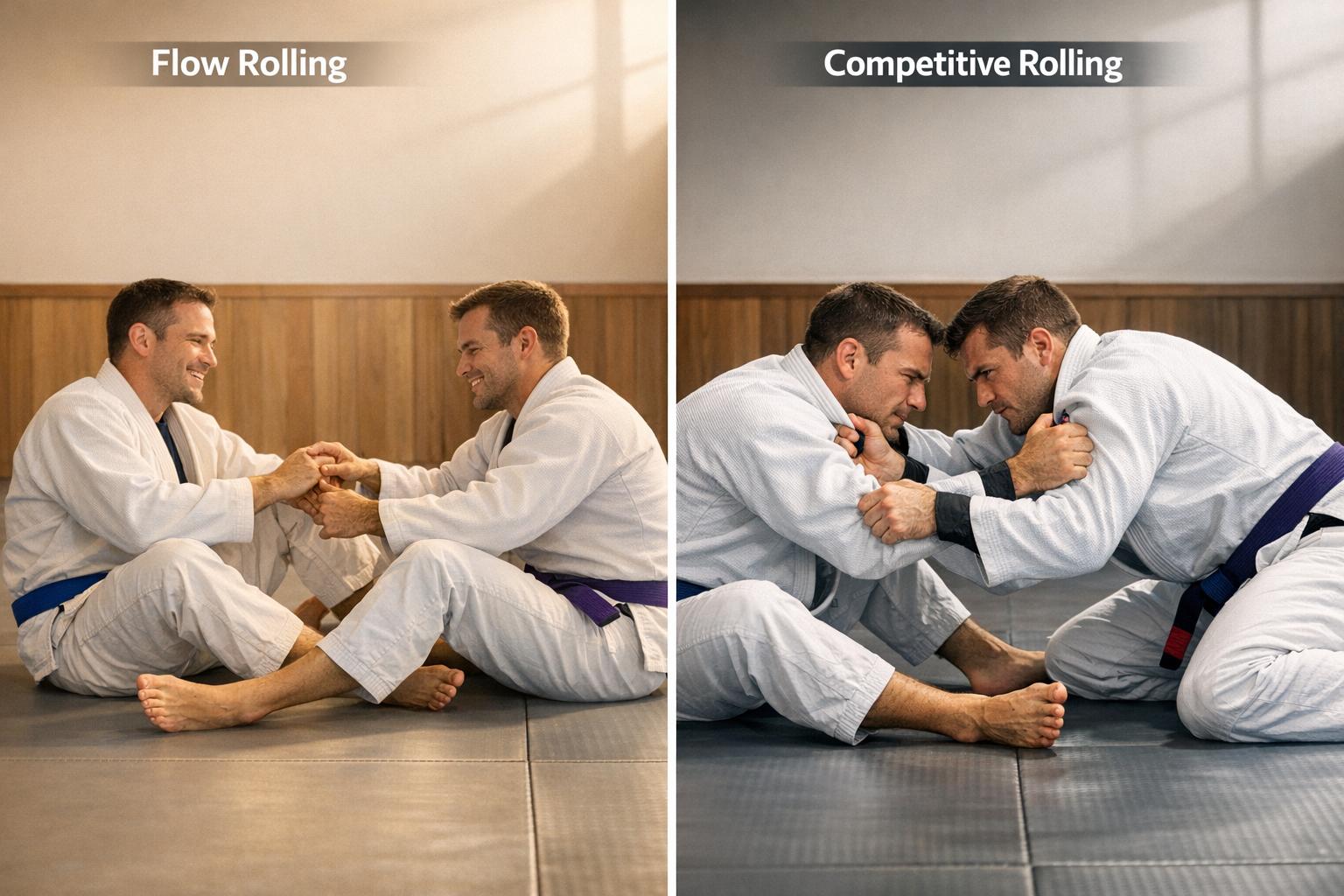
Flow Rolling vs Competitive Rolling: Key Differences
Flow rolling and competitive rolling are two distinct Brazilian Jiu-Jitsu training styles, each offering unique benefits depending on your goals.
- Flow Rolling: A relaxed, cooperative approach focusing on smooth transitions and technique refinement. Partners use minimal resistance, making it ideal for recovery, learning new moves, and reducing injury risk.
- Competitive Rolling: An intense, resistive style that mimics real competition. It tests your skills under pressure, builds mental toughness, and prepares you for tournaments, though it carries a higher injury risk.
Quick Comparison
| Feature | Flow Rolling | Competitive Rolling |
|---|---|---|
| Intensity | Low to moderate | High to maximal |
| Resistance | Minimal, cooperative | Full, resistive |
| Primary Goal | Technique refinement, smooth transitions | Testing skills under pressure |
| Injury Risk | Low | Higher |
| Mental Focus | Relaxed, exploratory | High focus, stress management |
| Pace | Steady, controlled | Explosive bursts |
Key Takeaway: Use flow rolling for technical improvement and recovery. Opt for competitive rolling to sharpen your game and prepare for high-pressure scenarios. Balancing both is essential for well-rounded training. If you're looking for a place to practice these styles, you can find a BJJ gym that fits your training needs.
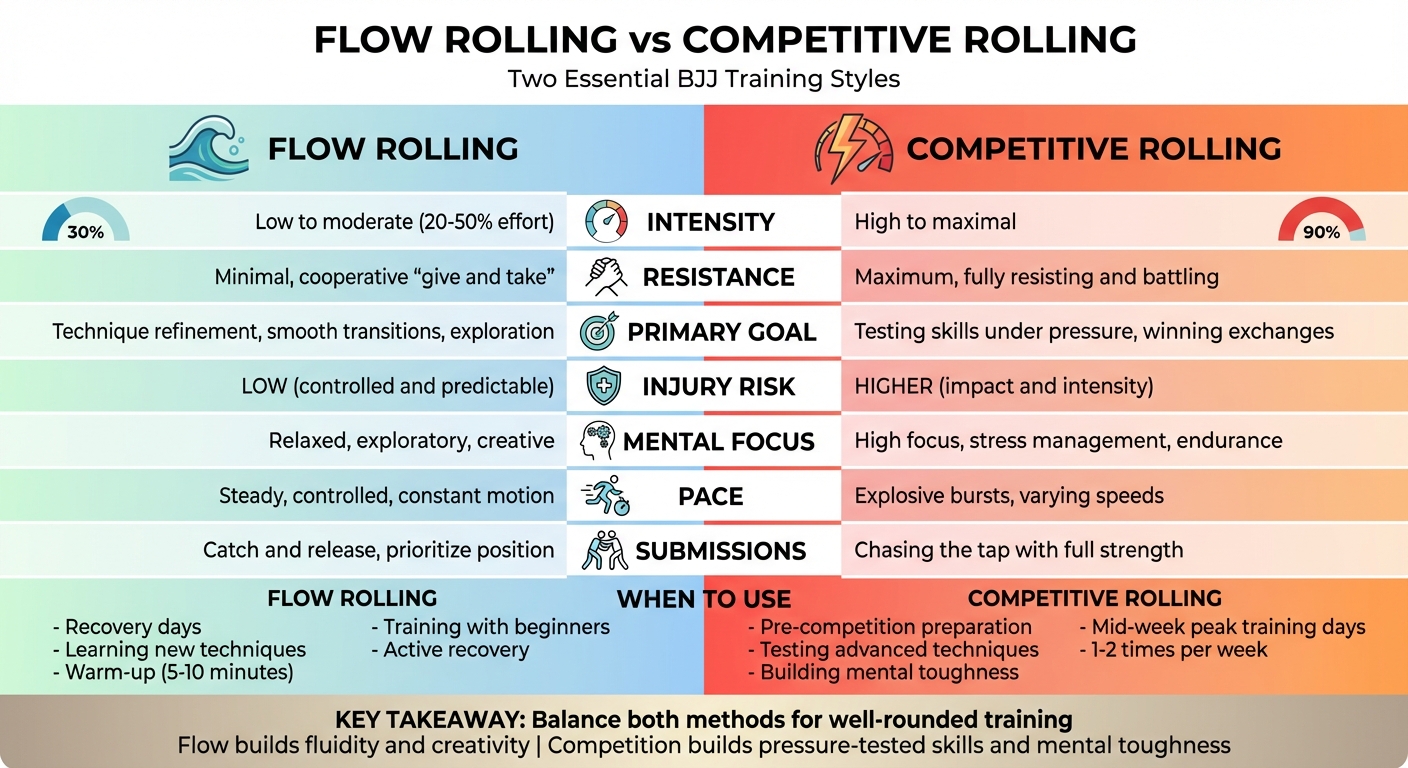
Flow Rolling vs Competitive Rolling: Complete Comparison Guide
Professional BJJ Training Vs Older Non Competitor Training with Brian Glick and Giancarlo Bodoni
sbb-itb-d583f1e
What is Flow Rolling?
Flow rolling is a relaxed, cooperative training method in Brazilian Jiu-Jitsu (BJJ) where two practitioners move together in harmony rather than competing against each other. Picture it as a smooth, back-and-forth exchange on the mats - no winners, no egos, and no rush. Instead of aiming to dominate, both partners focus on continuous movement, exploring techniques, and transitioning seamlessly.
Typically, the intensity stays between 20% and 50% of maximum effort [7]. This slower pace lets grapplers zero in on the finer points of their techniques without the pressure of a fully resistant partner.
"In a nutshell, flow rolling involves each player allowing the other just enough space and time to move to the next technique, ultimately resulting in an almost artistic display of various BJJ positions." – JiuJitsu.com [4]
This dynamic exchange highlights technical gaps that might not be apparent during high-intensity sparring. These principles form the foundation of flow rolling's unique approach.
Main Features of Flow Rolling
The standout feature of flow rolling is its cooperative and playful nature. Both partners agree beforehand to keep the pace light and the resistance minimal. As BJJ Black Belt Jesse Walker puts it, "No explosive motions, everything should be slow and controlled. No using strength to solve problems. Keep it moving and don't park anywhere for more than three seconds" [6].
Submissions in flow rolling are less about forcing a tap and more about demonstrating technical accuracy. Once a submission is secured, the partner often gets the chance to practice an escape, turning the session into a shared learning experience. This approach not only enhances skill development but also minimizes the risk of injury, making it a safe and effective way to train.
Flow rolling also promotes experimentation. Without the pressure to win, practitioners feel free to attempt advanced or unconventional techniques - such as a helicopter armbar - that they might shy away from in more competitive settings. This freedom fosters creativity and helps practitioners better understand how different positions connect.
When to Use Flow Rolling
Flow rolling is particularly useful on recovery days or when easing back into training after minor injuries. Its low-intensity nature allows practitioners to stay on the mats without overloading their bodies. It’s also a great tool for reinforcing new techniques, as the slower pace helps lock in muscle memory through repetition.
Many grapplers use flow rolling as a warm-up before diving into more intense training. A 5–10 minute session can gradually prepare the body while sharpening timing and anticipation. For upper belts, flow rolling is an excellent way to train with beginners, offering newer students a chance to build confidence while advanced practitioners refine their transitions and timing.
This method is perfect for focusing on fluidity and creativity without the physical strain of hard sparring. Some even call it the "California Roll", a nickname that reflects its laid-back, surfer-like vibe. Whether you're fatigued or looking to hone technical precision, flow rolling provides an ideal environment for productive and enjoyable training.
What is Competitive Rolling?
Competitive rolling - commonly referred to as hard sparring - sits at the intense end of the training spectrum, far removed from the cooperative nature of flow rolling. Here, every exchange is amplified with full resistance, as both practitioners employ every skill in their arsenal to dominate or submit their partner. This involves grip fighting, applying pressure, dynamic scrambles, and genuine submission attempts. The objective? To test your techniques in conditions that mimic a tournament or real-life confrontation [3][7].
"Hard sparring is the opposite side of the training coin. It's a fully competitive roll, where each grappler tries to dominate or submit the other using all available tools - grip fighting, pressure, scrambles, and more." – RollBliss [3]
Unlike flow rolling, which encourages collaboration, competitive rolling is all about opposition. There's no room to let your partner work freely - every move is a battle for control. This approach not only exposes weaknesses in your game but also builds the mental toughness needed for high-pressure situations like competitions [3][7]. The intensity of this method deserves a closer look at its defining features.
Main Features of Competitive Rolling
The hallmark of competitive rolling is complete resistance. Your partner isn't there to assist; they’re actively trying to counter your moves, pass your guard, or secure a submission. The pace tends to be fast and explosive, requiring physical strength, quick reflexes, and sharp technique.
This type of sparring demands a mindset geared toward winning exchanges, holding dominant positions, and finishing submissions. It’s physically taxing, pushing your heart rate up and causing muscle fatigue. Mentally, it challenges your focus and composure, especially when you're under heavy pressure or facing a submission threat [3].
"With competitive rolling, partners are matched so that they have a similar level of intensity, speed, and skill as well as being similar in size." – King Calisthenics [8]
However, the heightened intensity comes with a greater risk of injury compared to flow rolling. Explosive movements, high-pressure exchanges, and full-force submissions can lead to strains, sprains, or other injuries if practitioners aren't cautious [3][7].
When to Use Competitive Rolling
Competitive rolling is most effective when incorporated strategically into your training. It’s particularly useful during pre-competition preparation. As a tournament approaches, increasing your hard sparring sessions helps you adjust to the pace and pressure you’ll face on competition day [3]. It’s also the ideal setting to test advanced techniques, gauging how well they hold up against an opponent actively trying to counter them.
To get the most out of competitive rolling, choose partners who match your skill level, size, and intensity. Avoid engaging in hard sparring when you’re fatigued or recovering from an injury, as the physical demands can lead to burnout or setbacks [3].
This form of sparring is invaluable for developing the mental toughness and resilience required for high-stakes matches. It teaches you how to survive tough positions, remain calm under pressure, and execute techniques effectively, even when exhausted. These are skills you simply can’t build through drilling or flow rolling alone [3].
Main Differences Between Flow Rolling and Competitive Rolling
Flow rolling and competitive rolling differ significantly in how practitioners engage with each other, as well as the physical and mental demands they impose.
The main distinction lies in how partners interact. Flow rolling emphasizes a cooperative and fluid exchange, where both participants work together to explore techniques. On the other hand, competitive rolling is all about resistance - partners actively fight for control, applying maximum pressure to prevent their opponent's progress.
Physically, flow rolling maintains a steady, relaxed pace that promotes continuous aerobic movement. Competitive rolling, however, is marked by near-maximal effort and explosive bursts of energy, making it more anaerobic in nature.
Mentally, the two styles also diverge. Flow rolling encourages a calm, ego-free environment where creativity and technical experimentation thrive. Competitive rolling demands intense focus, the ability to manage stress under pressure, and the determination to push through tough situations.
"In a flow roll, you would likely either allow your opponent to get the underhook, or your opponent might allow the pass after a single pummeling exchange... In a hard roll, you would be hand fighting battling for the underhook and going for aggressive head position." – JiuJitsu.com [4]
Another key difference is the risk of injury. Flow rolling is generally safer because of its controlled and predictable nature, where submissions are caught and released without force. In contrast, competitive rolling carries a higher risk due to its intense, forceful movements and submissions that are often applied with full strength.
These differences shape not only the training experience but also factors like safety, endurance, and technical growth.
Comparison Table: Flow Rolling vs Competitive Rolling
| Feature | Flow Rolling | Competitive Rolling |
|---|---|---|
| Intensity | Low to moderate; relaxed and controlled | High to maximal; explosive and fast |
| Resistance | Minimal; cooperative "give and take" | Maximum; fully resisting and battling |
| Primary Goal | Exploration, fluidity, and timing | Testing skills under pressure; winning |
| Injury Risk | Low; controlled and predictable | Higher; due to impact and intensity |
| Mental Load | Creative, relaxed, and observant | High focus, endurance, and stress management |
| Submissions | Catch and release; prioritize position | Chasing the tap with full strength/control |
| Pace | Steady, constant motion | Varying speeds with explosive bursts |
Benefits of Flow Rolling
Flow rolling, with its cooperative approach, brings noticeable benefits in areas like technique, safety, and recovery.
One major advantage is technical refinement. Since partners provide minimal resistance, you can zero in on the finer points of techniques - like hand placement, weight distribution, and body mechanics - without distractions. As Evolve MMA puts it, "Flowing allows you to focus on the finer details of techniques as you roll, allowing you to learn how to execute them correctly" [2]. This focused practice not only improves technique but also promotes safer training habits.
Another key benefit is reduced injury risk. Injuries in Brazilian Jiu-Jitsu often stem from accidental impacts - whether it’s colliding with a partner or hitting the mat during fast-paced scrambles. Flow rolling minimizes these hazards by keeping the pace controlled and cooperative. JiuJitsu.com highlights this, stating, "Flow rolling allows you to practice jiu-jitsu and improve your technical game with a much lower impact and injury risk compared to all-out rolling" [4].
Flow rolling also supports recovery. On days when your body needs a break but you still want to train, flow rolling offers a way to stay active without overloading your muscles or nervous system. It allows you to refine your timing and build skills while giving your body the chance to recover from tough sessions or minor injuries [5][7].
How Flow Rolling Improves Your Training
Flow rolling doesn’t just build skills - it transforms how you train by improving positional awareness and encouraging creativity.
It enhances positional awareness by teaching you how positions naturally transition into one another [5]. For instance, you might learn how to flow smoothly from side control to north-south and then into mount. This fluidity allows for more technical repetitions in a single session compared to competitive rolling [2][1].
The relaxed environment also promotes technical creativity. Without the pressure of winning or losing, you're more likely to try advanced moves - like helicopter armbars or unconventional transitions - that you might shy away from during intense sparring. Over time, this experimentation deepens your skill set and makes your game more adaptable [2][3]. Moreover, flow rolling fosters a calm and focused mindset, helping you respond thoughtfully rather than reacting out of panic or ego [2].
Benefits of Competitive Rolling
Competitive rolling pushes your skills to the limit, testing your techniques and building mental toughness. In this type of training, your partner applies full resistance - using grip fighting, pressure, and scrambles to challenge every move you make [3][9]. This intensity mirrors the high-stakes environment of a real tournament, where every moment counts.
One major advantage is uncovering weaknesses in your game. Rolling competitively reveals which techniques hold up under pressure and which ones falter against a determined opponent [4][10].
"Competitors don't just learn a move - they refine it, drill it repeatedly, and test it under pressure." - Nicholas Salles from Movement Art Brazilian Jiu-Jitsu [10]
Physically, competitive rolling prepares your body for the demands of tournaments. The pace and intensity mimic back-to-back matches, conditioning your cardiovascular system and enhancing explosive movements in ways that drilling alone can't achieve [10][11]. It also sharpens your reaction time, pushing you to make quick, decisive moves even under stress [3]. These physical and mental benefits combine to create a sharper, competition-ready mindset.
How Competitive Rolling Improves Your Training
This type of rolling acts as a reality check for your entire skill set. It shows whether your setups, timing, and leverage hold up when someone is actively working to counter you [3][7]. Beyond technique, it builds mental toughness by teaching you to remain calm in tough spots and escape without panicking - an essential skill both on and off the mats [3][10].
"Competition training isn't just about technique - it's about mindset. Whether you compete or not, learning how to stay calm under pressure is a game-changer." - Nicholas Salles [10]
Hard rounds also teach you to push through exhaustion. Instead of giving up when fatigue sets in, you learn to keep going, which is crucial in both training and competition. Competitive rolling also helps you refine your "A-game" by focusing on techniques that consistently work, shaping a solid game plan. Keeping a training journal to track moves that fail during these sessions can highlight areas needing improvement.
To maximize the benefits, choose training partners who match your intensity but still respect physical limits [3].
"Months or weeks before the competition, it is critical that you shift to a more serious mindset and increase the intensity of your training to mimic the competition environment." - Evolve MMA [9]
Since competitive rolling is physically taxing, balance it with flow rolling to reduce strain, and aim for 7–9 hours of sleep each night to recover fully and avoid burnout or injury.
How to Balance Flow Rolling and Competitive Rolling
Blending flow rolling and competitive rolling in your training routine is key to improving your skills while avoiding burnout. A well-rounded schedule should include technical drills, flow rounds, and live sparring at varying levels of intensity [3]. The trick lies in tailoring your approach to your physical condition, goals, and competition timeline.
Flow rolling is a must-have in every training week for building smooth transitions and better connection on the mats [3]. Use it as a 5–10 minute warm-up to get into the zone or as a cool-down to safely wind down after intense sparring sessions [3][5][7].
On lighter recovery days, swap out competitive sparring for flow rolling [3][7]. This lets you stay active without putting extra strain on your body. If you find yourself relying too much on strength instead of technique or feeling overly fatigued, adjust your routine accordingly [1][4].
Your competition schedule should also influence your training. As a tournament approaches, ramp up your hard sparring sessions to sharpen your edge. During competition week, shift to flow rolling to refine techniques while reducing the risk of injuries [9]. As Evolve MMA wisely says:
"Slow is smooth, and smooth is fast" [9].
How to Structure Your Weekly Training Schedule
A good weekly schedule strikes a balance between learning and testing your skills. Here’s a breakdown:
- Early in the week: Focus on learning new techniques through flow rolling during technical sessions. This is the time to experiment and refine.
- Mid-week: With energy levels at their peak, schedule 1–2 competitive rolling sessions to put your skills to the test under pressure [3].
- End of the week: Use flow rolling for active recovery after heavy sparring sessions, giving your body a chance to recover while staying engaged.
Before each round, communicate with your partner to set clear expectations about intensity [2][3]. A quick, “Let’s keep this light and playful,” can avoid mismatched energy levels. For upper belts, flow rolling with lower belts is a chance to focus on technical transitions while helping beginners learn [12][9]. If you find yourself in a dominant position during flow rolling, ease up the pressure to allow your partner to practice escapes [4].
| Training Goal | Recommended Method | Frequency/Timing |
|---|---|---|
| Learning New Techniques | Flow Rolling | Early in the week or technical blocks |
| Competition Readiness | Competitive Rolling | Mid-week, peak training days |
| Injury Management | Flow Rolling | Replace high-intensity rounds |
| Mental Toughness | Competitive Rolling | 1–2 times per week |
| Active Recovery | Flow Rolling | End of the week or after heavy sessions |
Balancing these elements ensures steady progress without overtraining. While hard sparring is essential for growth, too much of it can lead to injuries and fatigue [3]. Mixing in flow rolling keeps your training effective, sustainable, and enjoyable.
Conclusion
Flow rolling and competitive rolling each play a unique role in Brazilian Jiu-Jitsu (BJJ) training. Flow rolling encourages fluid movement, creativity, and technical precision in a relaxed setting. On the other hand, competitive rolling puts those skills to the test in high-pressure situations, building the mental toughness and resilience needed for tournaments.
As BJJ World explains:
"Flow rolling is going to get you ready to both destroy people at tournaments and achieve constant progress in BJJ." (BJJ World)
The key is knowing when to use each method. Flow rolling is ideal for recovery days, refining techniques, and expanding your game. Competitive rolling, meanwhile, challenges you to perform under pressure and sharpens your skills. Over-relying on hard sparring can lead to stagnation, as it often encourages sticking to familiar techniques. Flow rolling counters this by keeping your game dynamic and adaptable.
Consider your goals and physical condition when deciding which approach to take. If you're feeling fatigued, nursing an injury, or working on new techniques, flow rolling allows you to stay active without overexerting yourself. When you're feeling strong and ready to push your limits, competitive rolling helps you refine those pressure-tested skills. The most successful practitioners understand the importance of balancing both methods.
As RollBliss puts it:
"Flow builds fluidity, creativity, and timing; sparring builds pressure-tested skills and mental toughness." (RollBliss)
FAQs
How do I ask a partner for a true flow roll?
To set up a true flow roll, be clear and upfront about your intentions. You could say something like, "Would you be up for a flow roll? I want to focus on smooth movement and technique without going too hard." This kind of direct communication helps your partner understand that you're aiming for a relaxed, cooperative session centered on skill development rather than an intense or competitive roll.
How often should I hard spar each week?
The number of hard sparring sessions you should have each week depends on your experience and objectives. Typically, limiting these sessions to 1-3 times per week is a good rule of thumb. This approach reduces the risk of injuries and avoids overtraining. For the rest of the week, prioritize flow rolling or lighter sparring. These sessions allow you to sharpen your techniques while keeping things safer and less physically taxing.
Can beginners do competitive rolling safely?
Flow rolling is often recommended for beginners. It's a lighter and more cooperative style of sparring that emphasizes technique, movement, and control. This approach not only reduces the risk of injuries but also creates a safer space for newcomers to build their confidence and develop foundational skills. As they progress and improve their control, beginners can slowly transition to more intense and competitive rolling, always keeping safety and proper technique as top priorities.
Related articles
Share this article