
No-Gi vs. Gi: Training Adjustments for Rule Changes
How Gi and No-Gi rule changes affect training: heavier gis and tighter grip limits, 50/50 shot clock, heel hooks legal in No-Gi, slams banned, and drills to adapt.
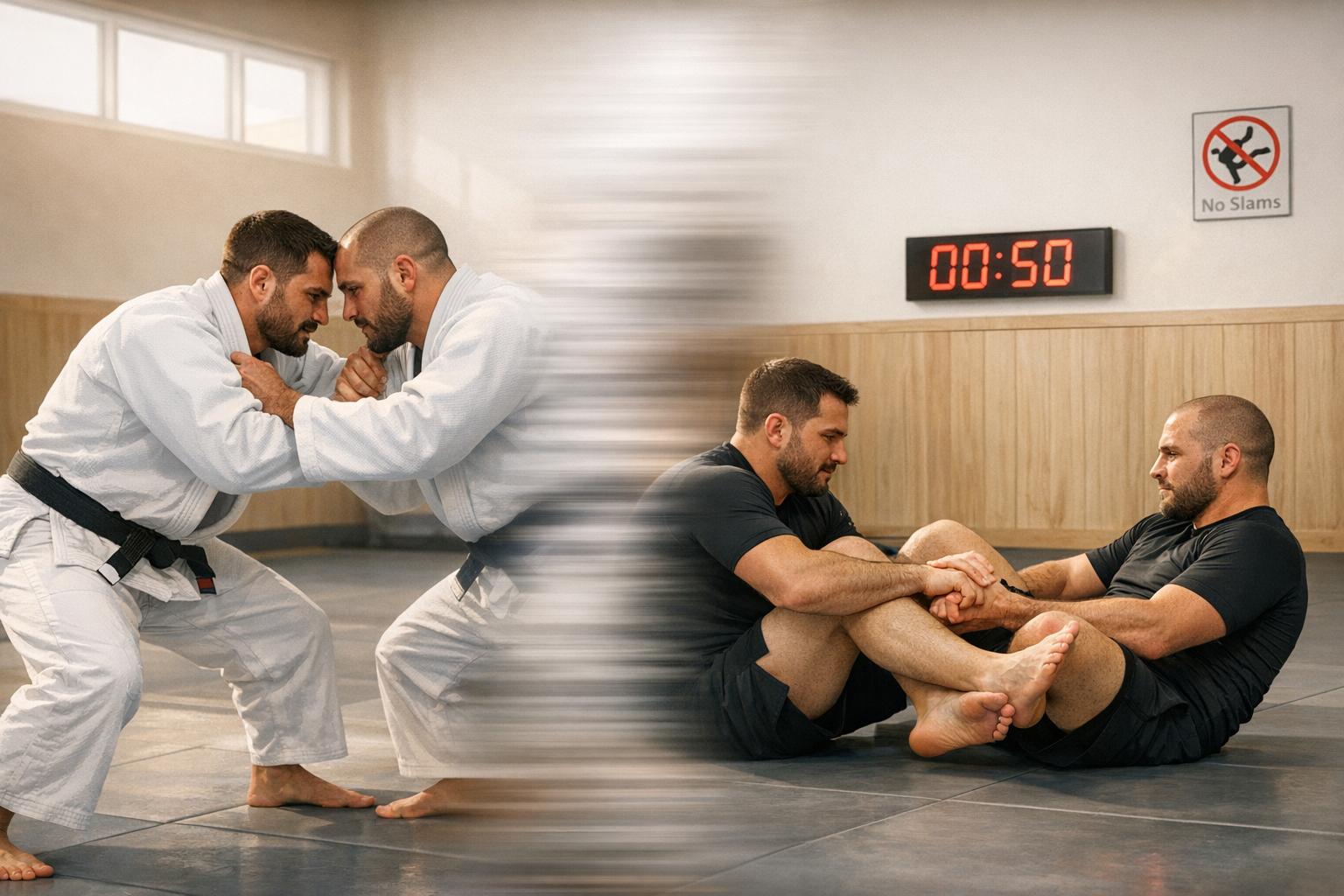
No-Gi vs. Gi: Training Adjustments for Rule Changes
Choosing between Gi and No-Gi training in Brazilian Jiu-Jitsu has become more complex due to recent rule changes. Here's what you need to know:
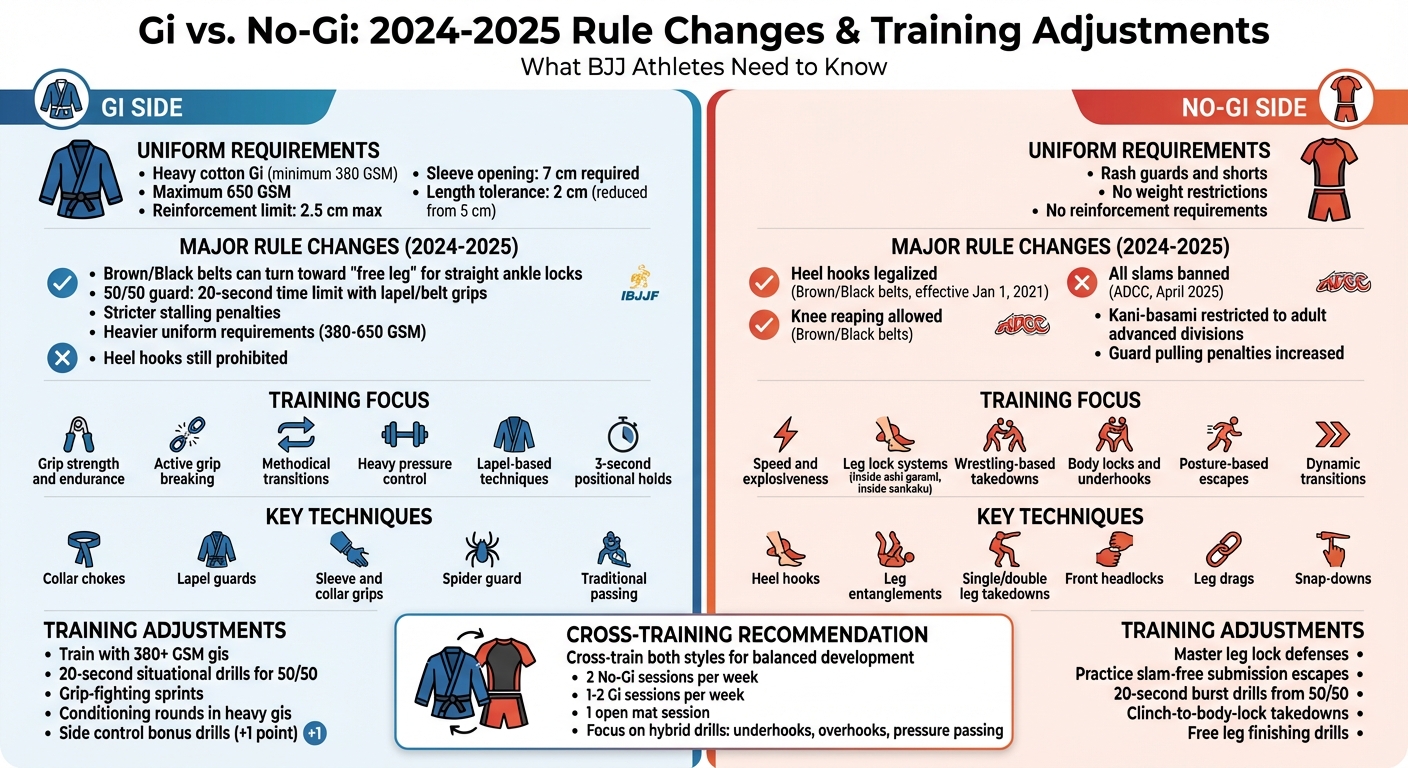
- Gi Training: Focuses on grip strength and control using the Gi. New rules now require heavier uniforms (minimum 380 GSM), stricter reinforcement limits, and tighter stalling penalties in 50/50 guard.
- No-Gi Training: Emphasizes speed, dynamic movement, and wrestling-based techniques. Updates include the legalization of heel hooks, bans on slams, and penalties for guard pulling, shifting the focus to precision and transitions.
Key Adjustments:
- Gi practitioners must train grip endurance and adapt to heavier uniforms.
- No-Gi athletes need to master leg locks, takedowns, and posture-based escapes.
- Cross-training both styles helps build a balanced skill set. If you're looking to start your journey, you can find a BJJ gym nearby that offers both styles.
Quick Comparison:
| Aspect | Gi | No-Gi |
|---|---|---|
| Uniform | Heavy cotton Gi (min. 380 GSM) | Rash guards and shorts |
| Techniques | Grip-based controls, lapel chokes | Leg locks, wrestling-based takedowns |
| Rule Changes | Heavier uniforms, stricter stalling rules | Heel hooks legalized, slams prohibited |
| Focus | Grip strength, methodical transitions | Speed, dynamic movement, precision |
Adapting your training to these changes is critical for success in competition.
Gi vs No-Gi BJJ Training: 2024-2025 Rule Changes and Key Differences
Recent Rule Changes in Gi Competitions
Major Rule Updates in Gi Competitions
The IBJJF has rolled out some important rule changes for 2024, and they’re bound to shake things up for competitors. One of the biggest updates? Brown and black belt athletes can now turn toward the "free leg" when applying a straight ankle lock. Previously, this move would get you disqualified on the spot, but now it’s a legal finishing option [6]. This opens the door to fresh mechanics that advanced practitioners will need to master.
Another significant tweak focuses on stalling in the 50/50 guard. Athletes now have 20 seconds to advance their position when using lapel or belt grips. If they fail to do so, they’ll be penalized for lack of combativeness [6]. This "shot clock" style rule is designed to keep matches more dynamic and discourage static gameplay.
Uniform standards have also tightened. Gi jackets are now required to weigh between 380 GSM and 650 GSM, effectively phasing out ultralight gis that used to weigh as little as 325 GSM [7][8]. On top of that, reinforcements on sleeves, cuffs, and jacket skirts can’t exceed 2.5 cm. These changes aim to eliminate "ungrippable" areas on uniforms, ensuring no competitor gains an unfair edge through gear design [7].
These updates are reshaping competitive strategies and call for immediate adjustments in training and preparation.
How Rule Changes Affect Gi Training
With these new rules, training routines need to shift to keep up. The heavier uniform requirements mean athletes will have to focus more on grip strength and endurance. Thicker fabrics demand more effort to control, so competitors will need to build the stamina to handle the extra resistance. Additionally, cutting weight might get trickier, as heavier gis will now factor into the equation. Athletes should swap out their ultralight gis for options that meet the 380 GSM minimum.
The 50/50 guard rule also demands a new approach. Coaches should integrate 20-second situational drills into training, focusing on quick transitions to sweeps or passes while maintaining lapel grips [6]. This shift prioritizes active movement over static control, so practice sessions will need to reflect that.
For brown and black belts, the changes to the straight ankle lock rule mean it’s time to rethink old habits. Turning toward the free leg is now a viable finishing move, so drilling this technique is essential [6]. For athletes used to avoiding this direction to sidestep disqualification, it’s a major adjustment. Overall, these changes call for a recalibration of both technique and conditioning, much like what we’ve seen in No-Gi competition adjustments.
sbb-itb-d583f1e
Recent Rule Changes in No-Gi Competitions
Major Rule Updates in No-Gi Competitions
No-Gi competitions have introduced rule changes that significantly alter match strategies. Starting in April 2025, ADCC will no longer allow slams in any division [12][13]. This means athletes can no longer use slams to escape submissions like triangles or armbars:
"All slams are now illegal in all divisions. You can no longer slam to escape a submission." [12]
Another key update from ADCC restricts the kani-basami (scissor takedown) to adult advanced divisions in ADCC Open tournaments. This move aims to reduce the risk of serious knee injuries, encouraging competitors to explore safer techniques [12][13].
Meanwhile, the IBJJF implemented a pivotal rule change on January 1, 2021, allowing heel hooks and knee reaping for adult brown and black belts in No-Gi divisions:
"Heel hooks and knee reaping for Black and Brown Belt adult NoGi Divisions, will be valid starting on January 1st, 2021." [14]
These changes reflect a growing emphasis on athlete safety while also expanding the technical options available to experienced practitioners. Organizations like ADCC are testing these safety-focused rules in regional Open tournaments before rolling them out at higher levels [13]. As a result, competitors and coaches are adjusting their training approaches to adapt to these shifts.
How Rule Changes Affect No-Gi Training
The updated rules have shifted the focus of training toward precision and technical skill rather than reliance on high-impact techniques. With slams now banned, athletes must develop alternative submission escapes. Instead of lifting opponents to break out of armbars or triangles, practitioners are drilling posture-based escapes that emphasize timing, hip alignment, and hand positioning [13].
For brown and black belts, the legalization of heel hooks has made leg lock systems a critical part of training. Competitors are now dedicating time to mastering leg entanglements, heel hook setups, and effective defenses to stay competitive in No-Gi matches [11].
The restriction on kani-basami has also encouraged the use of safer takedowns. Techniques like single-leg entries, body locks, and arm drags are becoming more prevalent as athletes seek reliable alternatives [13].
Additionally, with fewer high-impact moves allowed, training has shifted toward refining transitions and maintaining positional control. Under IBJJF rules, competitors gain points by stabilizing positions for about three seconds, rewarding a more methodical and controlled approach rather than explosive techniques [9]. As BJJEE Editorial observed:
"The rule changes encourage competitors to find safer, more technical ways to win, which may lead to more thoughtful matches and cleaner execution." [13]
Training Adjustments for New Gi Rules
Modifying Grips, Guard Passing, and Control
Gi athletes are facing a shift in how they train, thanks to stricter IBJJF uniform standards. The introduction of a 380 GSM minimum weight in gis means increased fabric friction, making it easier for opponents to secure and hold grips [7]. This change contrasts sharply with No-Gi training, where fluid transitions and leg lock systems dominate the focus.
With the new 2.5 cm reinforcement limit, athletes can no longer depend on stiff cuffs to resist grips. Instead, they must actively break grips through deliberate techniques. As John Danaher observed:
"These rule changes represent a significant step towards standardization in BJJ competitions. They level the playing field and push the sport towards greater professionalism" [15].
The 7 cm sleeve opening requirement ensures that opponents always have a grip to work with, compelling practitioners to accept this reality and refine their counter-control strategies [16]. Additionally, the reduced sleeve and pant length tolerance - from 5 cm to just 2 cm - means more fabric is available for opponents to grab, requiring better defensive positioning and awareness.
These changes also impact strategy. For example, organizations like AGF now reward positional control with a +1 point bonus for holding Side Control or North-South positions, while penalizing guard jumping by awarding 1 point to the opponent [17]. This shift places greater emphasis on heavy pressure and maintaining control over quick, explosive movements.
The table below breaks down these adjustments and provides training drills to help athletes adapt effectively.
Comparison Table: Gi Training Adjustments
| Rule Change | Old Approach | New Adjustment | Training Drill |
|---|---|---|---|
| 380 GSM Minimum Weight | Using ultra-light gis for speed | Training with heavier gis to handle fabric drag | Conditioning Rounds: Sparring in heavy gis to build endurance and adapt to friction |
| 2.5 cm Reinforcement Limit | Relying on stiff cuffs to deter grips | Active grip breaking and hand-fighting | Grip-Fighting Sprints: One-minute rounds focused on stripping sleeve and collar grips |
| 7 cm Sleeve Opening | Tapered sleeves to restrict grip handles | Developing smarter counter-control techniques | Spider Guard Drills: Practice establishing and clearing grips from guard positions |
| 2 cm Length Tolerance | Shorter sleeves/pants to hide extremities | Defending against more exposed wrists/ankles | Ankle Pick and Sleeve-Drag Defense: Drills to protect wrists and ankles during passing |
| Side Control Bonus (+1 pt) | Prioritizing the pass without stabilization | Emphasizing heavy pressure and 3-second holds | Positional Sparring: Start from near-pass positions and focus on maintaining control for three seconds |
These adjustments reflect a broader push toward refining technique, improving control, and adapting strategies to match the evolving competitive landscape.
Training Adjustments for New No-Gi Rules
Improving Transitions, Leg Locks, and Body Locks
No-Gi grapplers are now putting a stronger emphasis on transitions and leg locks. Since the 2021 rule changes for adult brown and black belts, leg entanglements have gone from being a specialized skill to a cornerstone of competitive strategy. Techniques like inside ashi garami and inside sankaku are now key positions for executing heel hooks effectively.
These changes mean athletes need to rethink their approach to control and transitions. Without the grips provided by a gi, practitioners must lean on wrestling-inspired techniques. As Gordon Ryan explains:
"In no-gi, you must excel with hand techniques, body positioning, and pressure generation" [2].
This shift has led to a focus on body-to-body control systems and wrestling-based transitions. Moves like snap-downs into front headlocks, as well as underhooks and overhooks, have taken the place of traditional collar drags and sleeve grips [19]. Advanced leg lock techniques now include turning toward the free leg to increase leverage - an approach that was once penalized with disqualification [6][10].
The 20-second stalling limit in the 50/50 guard has also changed the game. This rule forces competitors to stay active, either pursuing sweeps or submissions, instead of holding the position defensively [6]. Additionally, certain kani basami variations are now permitted for advanced No-Gi divisions, though the Imanari roll remains prohibited under IBJJF rules unless a grip is established before pulling guard [10].
Elite athletes like Helena Crevar have embraced these No-Gi systems, as seen in her CJI2 win over Sarah Galvao [2]. This evolution in strategy reflects a broader trend in Brazilian Jiu-Jitsu, with more emphasis on fast transitions and submission finishes rather than point-based control. These adjustments align with the rule changes and highlight the importance of dynamic, focused No-Gi training.
Comparison Table: No-Gi Training Adjustments
Here’s a summary of the key changes and drills to adapt No-Gi training for the updated rules:
| Rule Change | Old Approach | New Adjustment | Training Drill |
|---|---|---|---|
| Heel Hooks Legalized | Avoided leg entanglements that "reaped" the knee to prevent DQ | Focus on inside ashi garami and inside sankaku for heel hook finishes | Positional Sparring: Start in inside sankaku with heel hook focus |
| Straight Ankle Lock Direction | Turned toward the trapped leg to avoid DQ | Turn toward the free leg for better leverage (Brown/Black belt) | "Free Leg" Finishing Drills: Practice proper turning mechanics for straight footlocks |
| Guard Pulling Rules | Used Imanari rolls to transition directly into leg attacks | Establish a physical grip (wrist/neck) before sitting or rolling to guard | Grip-to-Guard Transitions: Drill proper entry sequences to ensure compliance with rules |
| 50/50 Stalling Rules | Held 50/50 to run out the clock or wait for a mistake | Demonstrate progression within 20 seconds | 20-Second "Burst" Drills: Train sweeps or submissions from 50/50 under time constraints |
| No Lapel Grips | Relied on collar and sleeve grips for static control | Use body locks, underhooks, and neck ties for connection | Clinch-to-Body-Lock Takedowns: Develop wrestling-based control systems |
Cross-Training Strategies for Changing Rules
Hybrid Drills to Combine Gi and No-Gi Skills
Cross-training encourages mastery of core techniques - like underhooks, overhooks, and leg locks - that are crucial for both Gi and No-Gi styles. Incorporating these into hybrid drills helps smooth the transition between the two formats. As Evolve University puts it, these controls are "like the king and queen of No-Gi" but remain equally important in Gi training [21].
Wrestling-based drills are particularly effective for cross-training. Techniques such as double-leg and single-leg takedowns, snap-downs into front headlocks, and sprawl-and-scramble recoveries are versatile and work across different rule sets [19][18]. Additionally, pressure passing techniques like leg drags - focused on body weight and agility rather than relying on grips - are equally effective in both styles [1].
Marcelo Garcia, a legendary IBJJF and ADCC champion, is known for blending the tight pressure and grip control of Gi with the speed and adaptability of No-Gi. He explains:
"I like to trust that Gi helps No-Gi and No-Gi helps Gi. I like to trust that because that's something that I, I have proved for myself, that's what makes my Jiu-Jitsu better" [22].
This hybrid method naturally leads to a well-rounded training routine that balances the strengths of each style.
Alternating Training Formats for Better Development
Building on hybrid drills, alternating your training sessions - such as two No-Gi, one or two Gi, and one open mat per week - helps avoid developing habits specific to just one style [19]. This method allows you to build the explosiveness and quick reactions needed for No-Gi while refining the technical precision and patience developed through Gi training [18][3].
Gi training, with its focus on grip control, sharpens your ability to detect threats early - an essential skill as modern rules demand tighter defense [21]. Escapes perfected under these conditions often prove even more effective in No-Gi settings [21][18]. On the flip side, No-Gi sessions enhance conditioning and reaction speed, which are increasingly important as Gi rules evolve to reward dynamic movement [20][3].
For instance, some academies structure their schedules to encourage well-rounded skill development [20]. Alternating formats also prevents over-reliance on grip-based controls like spider or lasso guard, ensuring your techniques are adaptable to any rule set [21][18]. Blending the strengths of both styles in your training ensures you stay prepared and competitive as the rules in both Gi and No-Gi continue to shift.
Conclusion: Preparing for the Future of Gi and No-Gi Training
Key Takeaways
Brazilian Jiu-Jitsu is evolving, and staying ahead means understanding the distinct demands of Gi and No-Gi formats. By 2025, the IBJJF has introduced heel hooks and knee reaping for adult brown and black belts in No-Gi competitions, while these techniques remain off-limits in Gi matches [9][11]. This shift highlights the growing technical divide, requiring athletes to tailor their training to each format's unique demands.
Gi training emphasizes grip control, deliberate transitions, and precise techniques. On the other hand, No-Gi training thrives on dynamic movements, wrestling-based strategies, and advanced leg lock systems [18]. Adding to the mix, the IBJJF's 2026 season brought stricter uniform requirements, such as a 380gsm minimum for Gi jackets and pants [4]. Keeping up with these changes is just as important as refining your skills on the mat.
Cross-training between Gi and No-Gi remains an effective way to build a well-rounded game. Alternating between the two and incorporating hybrid drills ensures you develop the technical precision required for Gi while cultivating the athleticism and explosiveness essential for No-Gi. These changes highlight the importance of training at a top-tier academy that can help you adapt and grow.
Using Brazilian Jiu-Jitsu Gyms Directory to Find Quality Training

Finding the right academy is key to putting these strategies into action. Look for academies offering balanced programs that align with the latest IBJJF rules. The Brazilian Jiu-Jitsu Gyms Directory (https://bjjacademyfinder.com) is a valuable resource for locating academies that stay updated with these changes. The platform allows you to search by location, program offerings, and instructor credentials, making it easier to find a facility that matches your goals.
Whether you're working on wrestling-heavy takedowns for No-Gi or preparing for IBJJF-compliant Gi competitions, this directory can connect you with academies equipped to meet your needs. In 2023, roughly 15% of competitors faced uniform-related issues at major IBJJF events [5]. Training at an academy that keeps pace with rule updates can help you avoid these pitfalls, ensuring you're ready to compete with confidence.
Does GI BJJ REALLY Improve Your NoGi Game?
FAQs
How should I adjust my training for heavier IBJJF-legal gis?
When preparing for IBJJF competitions, it's crucial to ensure your gi meets the updated regulations. This includes using jackets with a weight range of 380 GSM to 650 GSM. Heavier gis can affect your performance, especially when it comes to grip strength, so it's a good idea to train regularly with them to adjust to the extra fabric weight.
Pay attention to specific requirements like cuff reinforcement limits and correct label placement to avoid any issues during inspection. Practicing with compliant gear not only helps you adapt to its feel but also ensures you're fully prepared and won't risk disqualification.
What should I focus on now that heel hooks are legal in No-Gi?
With heel hooks now allowed in No-Gi competitions, it's crucial to prioritize injury prevention, as these techniques carry a high risk of knee injuries. Emphasize mastering proper technique, learning to tap early and safely, and developing strong defensive skills to protect against heel hooks.
In addition, focus on improving control and positional awareness to navigate these situations effectively. Take time to thoroughly understand the specific rules of your competition to avoid unnecessary risks. Striking a balance between offensive leg-lock strategies and safety precautions is key to adapting to this rule change while minimizing the chance of injury.
How can I cross-train Gi and No-Gi without building bad habits?
To cross-train effectively in Gi and No-Gi, it’s important to focus on the unique techniques and strategies each style requires. In Gi training, grips on the clothing play a major role, while No-Gi shifts the emphasis to body grips and control. Be mindful of not developing habits that don’t translate well between the two - like over-relying on clothing grips in Gi or ignoring them entirely in No-Gi. Consistent drilling with attention to detail is key to sharpening your skills. By progressing gradually and staying focused on technique, you can avoid developing counterproductive habits and improve overall performance.
Related articles
Share this article