
Ultimate Guide to BJJ Gym Etiquette
Clear BJJ gym etiquette for safety and respect—clean gear, tap early, follow class protocols, honor ranks, and keep mats and partners safe.
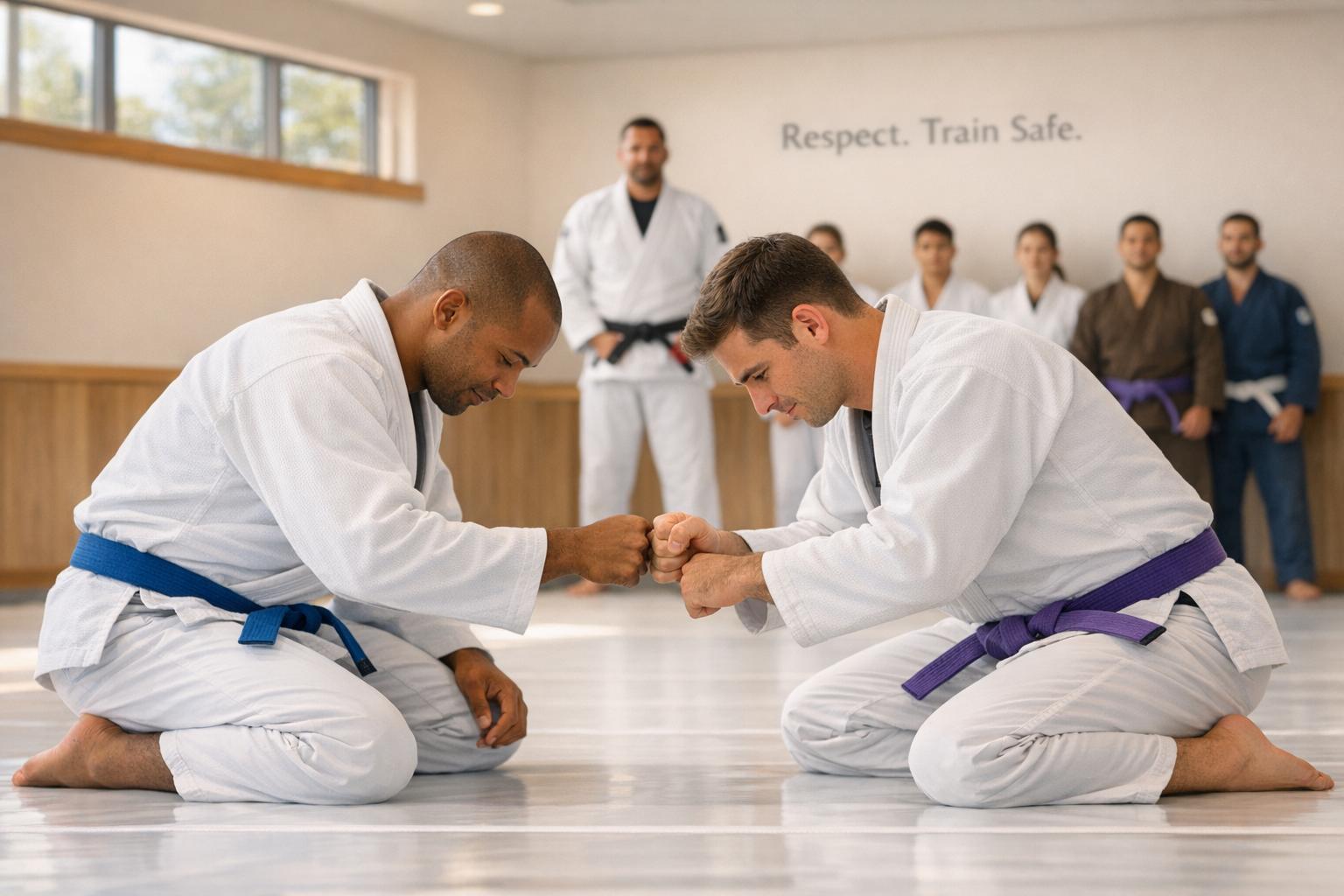
Ultimate Guide to BJJ Gym Etiquette
Brazilian Jiu-Jitsu (BJJ) etiquette is more than just manners - it's about safety, hygiene, and respect. Whether you're new or experienced, understanding these unwritten rules ensures a better training experience for everyone as you find your perfect BJJ gym. Here's what you need to know:
- Hygiene Matters: Keep your Gi clean, nails trimmed, and avoid training if you're sick or have a skin infection.
- Respect the Mat: Bow when entering or leaving, never wear shoes on the mat, and keep it clean.
- Follow Class Protocols: Arrive early, line up by rank, and give full attention during instruction.
- Sparring Etiquette: Tap early, apply submissions with control, and respect your partner's safety.
- Show Respect: Address instructors appropriately (e.g., "Professor" for black belts), and always thank your training partners after rolling.
BJJ gyms thrive on mutual respect and discipline. By adhering to these guidelines, you help create a safe, welcoming environment for everyone.
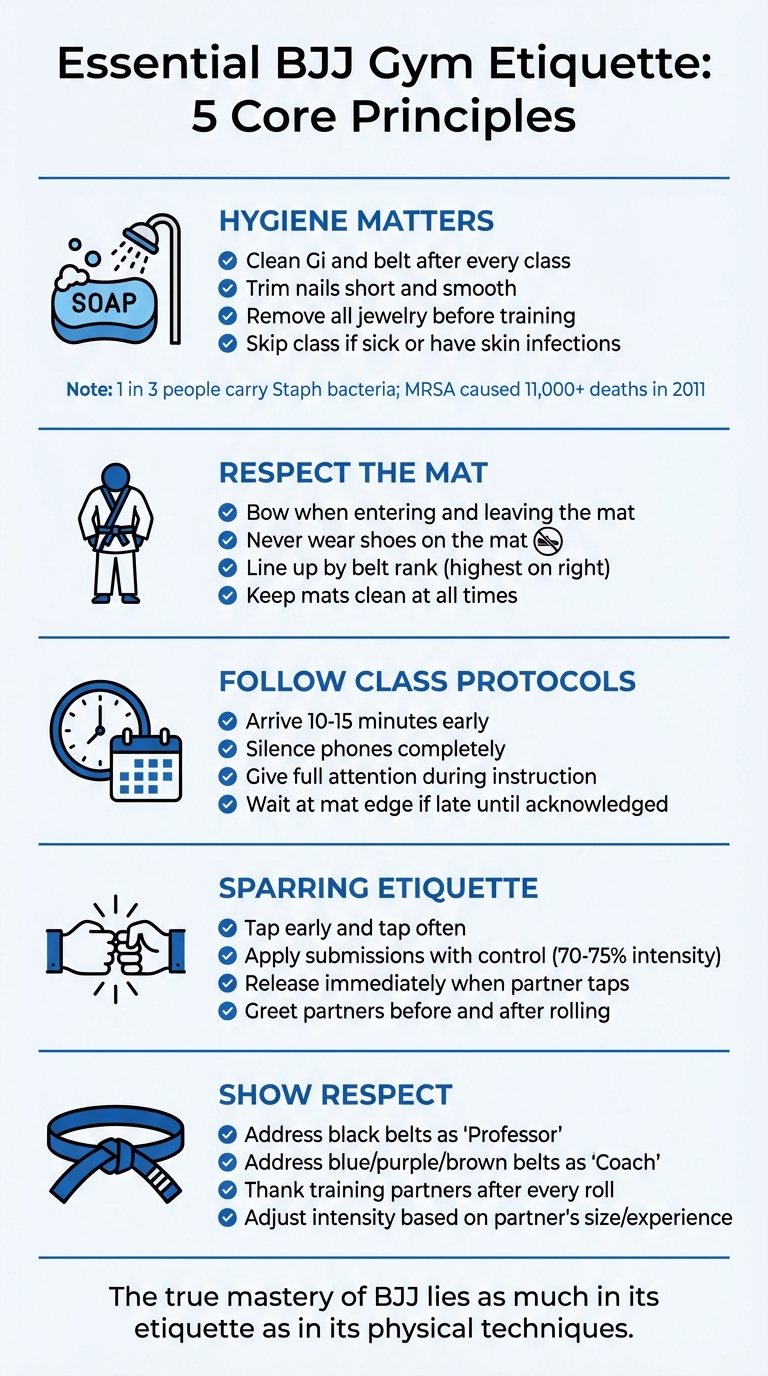
Essential BJJ Gym Etiquette Rules for Training Safety and Respect
Getting Ready Before Class
Personal Hygiene Requirements
Before stepping onto the mat, make sure your Gi and belt are freshly washed. This simple step reduces bacteria and keeps things hygienic for everyone. To maintain your Gi, wash it in cold water right after class - this helps prevent shrinking and keeps odors under control. Cleanliness is a big part of the respect and safety that Brazilian Jiu-Jitsu (BJJ) training relies on.
"The mats are hot, damp, sweaty places, making them fertile petri dishes for a host of nasty bacteria and fungi."
– Joe Hannan [6]
Keep your nails trimmed and smooth to avoid accidentally scratching your training partners. Carry nail clippers in your bag for quick fixes. Also, remove all jewelry - rings, earrings, watches, and piercings - before training. If you can’t take out a piercing, secure it with tape to prevent injuries.
If you've had a long day, take a quick shower before class and use deodorant. Fresh breath is also important in a sport that involves close contact, so brushing your teeth or using mints beforehand is a good idea. Avoid wearing strong perfumes or heavily scented lotions, as they can overwhelm others during training.
Cover any open wounds with bandages or athletic tape to protect yourself and your partners. If you suspect a skin issue like ringworm or staph infection - or if you’re feeling under the weather with a cold or flu - it’s better to skip class. Skin infections can spread quickly. For instance, about one in three healthy people carry Staphylococcus aureus on their skin, which can become dangerous if it enters through cuts. In 2011, the CDC reported over 11,000 deaths caused by MRSA [6].
Arriving at the Gym
Plan to get to the gym 10 to 15 minutes before class starts. This gives you enough time to change into your Gi, handle any paperwork, and mentally prepare for training. If it’s your first class, consider arriving even earlier to introduce yourself to the instructors and get familiar with gym policies.
"Aim to arrive at least 10 minutes before class starts. If you are late, you must wait respectfully by the side of the mat until the instructor acknowledges you and grants permission to join the class."
– Gracie Barra Lutz [3]
Never wear shoes on the mat. Instead, use flip-flops or sandals when walking around off the mat, especially in bathrooms, to avoid bringing dirt and bacteria onto the training area. A dedicated pair of "mat slippers" in your gym bag can help keep things clean.
"Your face ends up on the mat from time to time. You would want your face to end up where a dirty shoe that potential stepped in pee, poop, or unknown contaminants [was]."
– Black Girl White Gi [7]
While waiting for class to begin, keep a low profile in the lobby, store your belongings neatly in the designated areas, and make sure your phone is silenced. These small actions show respect for the space and your fellow students.
sbb-itb-d583f1e
JiuJitsu Gym Rules and Etiquette Explained
Mat Entry and Exit Protocols
Following consistent mat protocols not only upholds tradition but also ensures everyone's safety and respect.
Bowing When Entering and Leaving
Bowing is a gesture of respect for the mat, instructors, and the lineage of Brazilian Jiu-Jitsu (BJJ). Before stepping onto the mat, pause at the edge, face the center - or a portrait of a BJJ legend - and bow. Stand with your feet together, bow briefly, and then return upright [10].
"It is tradition to always pause briefly and bow before stepping onto the mat. When leaving the mat, turn around to face the mat and bow again before stepping off."
– Roxana Safipour, Easton Training Center [8]
If you arrive late or need to leave temporarily, bow after getting your instructor's acknowledgment [8] [9].
Once you’ve bowed, move to your spot on the mat, lining up according to your belt rank.
Lining Up by Belt Rank
At the start and end of class, students line up by belt rank to show respect for the hierarchy. Generally, the highest-ranking students stand in the front right corner when facing the mat. The line forms from right to left, with higher belts on the right and white belts typically at the far left or end of the line [2] [1] [9].
In no-gi classes, where belts aren’t worn, you can ask fellow students about their rank to find your place [1].
Conduct During Instruction and Drills
How you behave during instruction reflects the gym's core values of respect and safety. When the instructor begins speaking or demonstrating, stop all activity right away. Sit or kneel quietly and give your full attention. If you need to adjust your gi or retie your belt, step to the edge of the mat to avoid distracting others.
"When the instructor is demonstrating, there should be nothing but silence. Every comment or joke you have can wait for the end of class."
– Ogi, Head Coach at Enso Jiu Jitsu
Paying Attention During Demonstrations
Talking to your partner or practicing moves while the instructor is demonstrating disrupts the class and makes it harder for everyone to learn. Instead, focus on the explanation. If you have a question, raise your hand and wait until the demonstration is finished. Keep your question specific to the technique being taught and speak in a low voice. Also, ensure your phone is silenced or put away to avoid interruptions.
"It only takes one person to disrupt the flow of class and ruin it for everyone."
– Jiu-Jitsu Legacy
Listening carefully and following instructions sets you up to properly execute the techniques during drills.
Drilling Techniques Properly
When it's time to drill, stick to the method the instructor has shown. If one partner is higher-ranked, let them decide the drill order. Focus on controlled, precise movements and avoid coaching your partner unless asked.
"Stick to the technique that the instructor has taught when you are drilling. You have come to learn from the instructor, and the class is not the place to be trying out the latest technique you have watched on YouTube."
– JJB Admin, Jiu Jitsu Brotherhood
Trying out moves from YouTube or experimenting with counters during drills is a big no-no. It disrupts the class and goes against the purpose of drilling, which is to build muscle memory and refine technique - not to showcase personal skills or test new ideas.
Sparring and Working with Partners
Sparring, often referred to as "rolling", puts your techniques to the test in real-time. It’s where safety and mutual respect become non-negotiable.
When and How to Tap
Tapping is the universal way to signal that you're caught in a submission or feeling discomfort. The golden rule? Tap early and tap often - well before any pain sets in. You can tap by firmly patting your partner’s body, the mat, or even by yelling "Tap!" if your hands are tied up. The moment you tap, your partner must stop immediately - no questions asked.
"Tapping isn't losing it's a way of saying 'good job' to your training partner."
– Academy BJJ [12]
Trying to hold out only invites trouble. Serious injuries, like joint dislocations or being choked unconscious, are real risks if you don’t tap in time [13]. Tapping isn’t about giving up; it’s about staying safe so you can roll again tomorrow. A stark example of this occurred in August 2015, when Brazilian MMA fighter Rousimar Palhares held a kimura submission on Jake Shields during a World Series of Fighting bout. Despite Shields tapping repeatedly and the referee stepping in, Palhares continued applying excessive force. As a result, he was stripped of his title and banned from the promotion - a clear reminder of the importance of respecting the tap [13].
Once you’ve mastered tapping, the next priority is ensuring your partner’s safety.
Keeping Your Partner Safe
When applying submissions, do so with control and at a gradual pace. This gives your partner ample time to tap without risking injury. Always communicate openly about any pre-existing injuries and adjust your intensity to around 70–75% effort. If your partner is less experienced or physically smaller, focus more on technique and reduce your intensity even further.
Be mindful of your surroundings. If you and your partner roll too close to a wall or other pairs, pause and reposition to avoid accidents. If two pairs collide, it’s customary for the lower-ranked pair to yield space to the higher-ranked one.
Lastly, always acknowledge your partner after each roll. It reinforces the respectful and supportive environment essential to effective training.
Greeting Partners Before and After Rolling
Start and end each roll with a respectful gesture. Begin with a slap and fist bump, and conclude with a handshake and a word of thanks. No matter the outcome, express gratitude to your partner. Avoid comments like "you’re just stronger" or "how much do you weigh?" as they can downplay your partner’s skill. Instead, offer a genuine compliment on their technique - it helps build the mutual respect that keeps BJJ training enjoyable and safe for everyone.
Showing Respect to Instructors and Higher Ranks
Respect is a cornerstone of Brazilian Jiu-Jitsu (BJJ) culture. It’s not about blind obedience but about recognizing the dedication and effort that instructors and senior students have put into their training. Respect creates an environment where everyone can grow and learn effectively.
How to Address Instructors
Titles in BJJ reflect rank and tradition. Black belt instructors are typically addressed as "Professor", while those with blue, purple, or brown belts are referred to as "Coach." The terms "Master" or "Grand Master" are reserved for 7th/8th-degree and 9th/10th-degree red belts, respectively [14][15][8]. The title "Professor" comes from Portuguese, highlighting BJJ's Brazilian heritage [14][15].
"Anyone with a black belt should be addressed as 'Professor.' If your instructor is wearing a brown, purple, or blue belt, they should be addressed as 'coach.'"
– Roxana Safipour, Easton BJJ [8]
However, gym cultures can vary. Some academies emphasize formality with specific titles and bowing rituals, while others are more casual, often using first names [14][5]. Although some gyms might use the term "Sensei", it’s less common in BJJ [14][15]. To understand the expectations at your gym, observe how senior students interact with the instructor during your first few classes. This approach ensures you align with the norms of your specific academy while reinforcing the importance of respect.
Being on Time and Asking Permission
Respect in BJJ isn’t just about titles - it’s also reflected in how you conduct yourself on the mat. Punctuality is key. If you arrive late, stand at the mat’s edge and wait for the instructor to acknowledge you before stepping on [5][11]. Similarly, if you need to leave early or step off the mat, always ask for permission first [2][11].
"If you're late, wait at the mat's edge until acknowledged by the instructor."
– White Belt Club [5]
During instruction, sit upright rather than lying down or leaning against the wall. Slouching can come across as disrespectful [11]. If you have a question, wait until the instructor finishes demonstrating before speaking up. These small but meaningful actions show that you respect your instructor’s time and expertise. They also contribute to the disciplined and focused environment that helps everyone learn effectively.
General Gym Behavior
Respect on the mat is just the beginning - your actions throughout the gym play a big role in shaping the overall training culture. A Brazilian Jiu-Jitsu (BJJ) gym thrives when it becomes more than just a place to learn techniques. It should feel like a space where everyone feels safe, respected, and motivated to grow.
Maintaining Mat Cleanliness
Keeping the mats clean isn’t just about hygiene - it’s about showing respect for the space and everyone who trains there. One of the simplest rules? Leave outdoor shoes at the door. Always have a pair of indoor-only shoes for quick trips to places like the water fountain or restroom. This small habit keeps bacteria and dirt off the mats.
"The mats are only as clean as the feet that step on it."
– Team Pimentel BJJ & MMA
Other basics include keeping food, gum, and drinks off the mats. Your personal items, like gym bags or water bottles, should stay in designated storage areas, not scattered around the facility. If you happen to bleed during a roll, stop immediately to address it. Bandage the wound, clean any blood from the mats, and properly dispose of tape or band-aids. Many gyms also encourage students to help wipe down the mats after class. Pitching in not only keeps the space sanitary but also builds a sense of community.
Cleanliness isn’t just about the physical environment, though. It’s also about fostering a positive atmosphere.
Creating a Welcoming Environment
A professional and welcoming gym culture goes hand in hand with respect for everyone - whether it’s your instructor, training partners, or even newcomers. This means avoiding foul language, inappropriate jokes, or any form of discrimination. Keep conversations on the mat centered around Jiu-Jitsu rather than potentially divisive topics like politics or religion. And don’t forget to silence your phone to keep distractions at bay.
"BJJ gyms should be spaces where everyone feels welcome, regardless of their background, gender, or skill level. A no-discrimination policy is crucial to maintaining a positive training environment."
– Stoic BJJ
When rolling with partners of various sizes, ages, or experience levels, adjust your intensity. It’s not about overpowering someone smaller or less experienced - it’s about helping each other improve. Focus on learning, not proving dominance. If you submit your partner, there’s no need to brag. If you’re the one submitted, skip the excuses. A simple “thank you” at the end of a roll or class goes a long way in fostering mutual respect.
These small gestures and mindful actions help create the respectful, welcoming culture that makes BJJ gyms feel like a second home.
Choosing a Gym with Good Etiquette Standards
Finding the right Brazilian Jiu-Jitsu (BJJ) gym goes beyond convenience or cost. It's about choosing a place where etiquette and respect are woven into the culture. A gym with strong etiquette standards fosters a safer and more respectful environment - key for your growth and enjoyment in training. Before signing up, take the time to assess whether the gym's culture aligns with what you're looking for.
One of the best ways to gauge this is by observing a class. Pay attention to how students interact during sparring. Are higher belts guiding beginners, or are they overly aggressive? Octagon MMA highlights the risks of poor gym culture:
"If a gym promotes rolling to feed the egos of its members, that environment will result in injuries and toxicity" [16]
Look for signs of control during sparring and ensure submissions are released immediately when a tap is given. These are hallmarks of a respectful training space.
Hygiene is another critical factor. Check if the gym enforces rules like removing footwear before stepping on the mat and regularly disinfecting the mats. Even small details, like the cleanliness of the bathrooms, can give you insight into how well the gym is maintained.
Protocols and structure are equally important. Does the gym have clear systems in place, such as lining up by belt rank, addressing instructors with proper titles, and posting gym rules? As BJJ Buddy puts it:
"A customary code of conduct... amongst members of a gym who are literally simulating death or bodily harm on each other... is a must" [2]
Using the Brazilian Jiu-Jitsu Gyms Directory

To simplify your search for the right gym, you can use resources like the Brazilian Jiu-Jitsu Gyms Directory (https://bjjacademyfinder.com). This platform helps you find quality academies across the United States with location-based searches. Each profile includes valuable details like instructor credentials, available programs, and contact information.
The directory also features user reviews and ratings, which can help you identify gyms that are beginner-friendly, maintain cleanliness, and focus on technical training over brute strength. Be cautious of red flags like frequent injuries, unsanitary conditions, or high-pressure membership contracts.
Another handy feature is the interactive map, which allows you to compare multiple gyms in your area. Many academies offer free trial classes or even week-long passes, giving you a chance to experience the environment firsthand. Use these trial sessions to decide if the gym's etiquette and overall vibe align with your expectations and training goals.
Conclusion
BJJ etiquette forms the backbone of safe and respectful training. Simple practices like maintaining proper hygiene, tapping early, releasing submissions promptly, and following gym protocols ensure a positive experience for everyone involved. As Logan C., a BJJ Purple Belt and Coach at Citadel BJJ, wisely states:
"The true mastery of BJJ lies as much in its etiquette as in its physical techniques." [4]
The key principles outlined here - showing up on time, respecting the belt hierarchy, keeping the mats clean, and setting aside personal ego - help foster an environment where students can thrive. Whether you’re training in a traditional academy with formal customs or a more laid-back gym, the universal values of safety, respect, and hygiene are essential in any reputable training space. These principles should also guide you when selecting a gym to train at.
To make your search easier, the Brazilian Jiu-Jitsu Gyms Directory (https://bjjacademyfinder.com) connects you with top academies across the United States. The platform offers detailed gym profiles, instructor credentials, student reviews, and an interactive map to help you compare options. Many gyms even provide free trial classes, giving you the perfect opportunity to experience their training culture firsthand.
FAQs
What should I do if I have a cut or rash?
If you’re dealing with a cut or rash, keeping things clean and safe should be your top priority. Training with open wounds or skin infections isn’t just risky for you - it can also spread bacteria or fungi to others. Make sure to cover any cuts with a waterproof bandage, and let your instructor and training partners know about the situation.
Good hygiene is key here. Keep your skin clean and your nails trimmed to minimize risks. If you notice any skin issues, take the time to treat them properly and wait until they’re completely healed before jumping back into training. This way, you’re protecting both yourself and everyone else.
How hard should I roll with beginners or smaller partners?
When training with beginners or smaller partners, it's important to keep your movements light and controlled. This approach not only ensures safety but also allows both of you to focus on improving techniques without unnecessary pressure. Instead of relying on strength or intensity, aim to create a positive and productive training environment that prioritizes learning.
What are the red flags of a bad BJJ gym culture?
When evaluating a Brazilian Jiu-Jitsu (BJJ) gym, certain warning signs can indicate a problematic environment. These include unsafe sparring practices, where injuries are more common due to reckless behavior, and toxic instructors who may use intimidation or foster negativity. Poor hygiene is another major concern, as it can lead to health risks like skin infections.
Be cautious of gyms that tolerate aggressive or overly competitive behavior, discourage students from training elsewhere, or demand blind loyalty at the expense of personal growth. Other red flags include a lack of a clear, structured curriculum, mandatory gear purchases from the gym itself, and an emphasis on ego-driven training rather than prioritizing safety and technique.
Spotting these issues early can save you from joining an environment that could hinder your progress or even put your well-being at risk.
Related articles
Share this article