
Why Positional Sparring Improves Control Faster
Positional sparring speeds BJJ control gains with focused reps, structured resets, and role rotation. 15-30 min sessions, 2-3x per week.
Why Positional Sparring Improves Control Faster
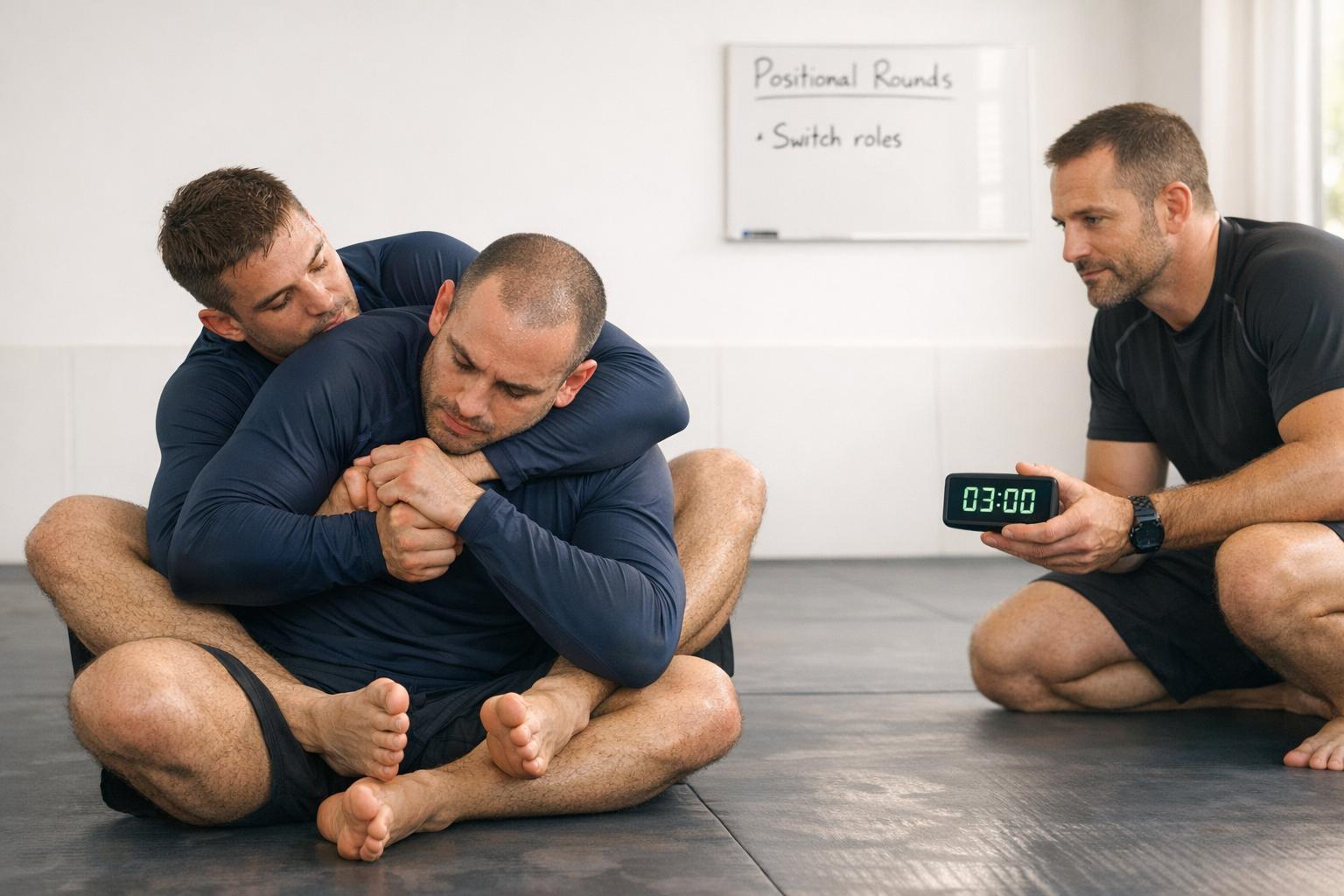
Positional sparring helps you improve control in Brazilian Jiu-Jitsu (BJJ) at a top-rated BJJ gym by focusing on specific positions, like mount or side control, rather than rolling freely. By resetting after each escape or submission, you get more targeted repetitions in less time. This method sharpens technique, builds confidence in weak areas, and reduces reliance on strength or speed. Unlike free rolling, which rarely gives enough practice in problem spots, positional sparring allows you to repeatedly work on key skills under controlled conditions.
Key Takeaways:
- Focused Practice: Start in a specific position and reset after each goal (e.g., escape, submission).
- Repetition: Get 10–20 reps per session compared to 1–2 in free rolling.
- Skill Development: Builds timing, pressure, and awareness in tough spots.
- Balanced Training: Forces you to address weaknesses and refine technique.
If you want to improve control faster, dedicate 15–30 minutes to positional sparring 2–3 times a week. Rotate positions and roles to cover both offensive and defensive scenarios. This structured approach helps you progress faster than free rolling alone.
Stop Free Rolling and Start Positional Sparring! - Kama Vlog
sbb-itb-d583f1e
Problems with Developing Control in BJJ
It’s a common struggle for BJJ practitioners to hit a plateau when trying to improve positional control. You might spend hours drilling techniques in class and rolling at the end of practice, yet still find yourself getting swept from mount or stuck in bottom side control. The issue here isn’t about effort - it’s that standard training often fails to provide enough targeted time in the positions where you’re weakest. This gap in focused practice reveals why relying solely on free rolling won’t get you to the next level.
Why Free Rolling Alone Doesn't Work
Free rolling is great for testing your overall skills, but it’s not the best method for sharpening specific positional control. Think about a typical five-minute roll: how many times do you actually end up in side control? Maybe once or twice, if that. That’s not nearly enough repetition to develop the timing, pressure, and awareness needed to truly master the position.
BJJ Black Belt Henry Akins puts it this way:
"The problem with just free rolling is when most people train, because of ego and wanting to WIN, they always look to go to positions where they are strong" [8].
This creates a cycle that’s hard to break. You instinctively stick to positions where you feel confident to avoid losing, which means the areas you struggle with get little to no attention. On top of that, stronger or more athletic training partners might rely on physicality rather than proper technique, which can hide gaps in their own skills and limit meaningful learning for both of you. Without structured practice, these challenges in maintaining and escaping positions remain unresolved.
Common Problems with Holding and Escaping Positions
To fix control issues, it’s important to understand the common mistakes that come with holding and escaping positions. Free rolling, with all its unpredictability, often makes it harder to pinpoint and address these problems. For example, if you lose back control during a roll, the match quickly moves on, leaving little time to analyze whether the issue was with your grip, weight distribution, or something else.
Another frequent problem is prematurely abandoning dominant positions. Many practitioners give up mount too quickly because they don’t feel confident in maintaining it. As Akins explains:
"I've talked to many people that do not feel comfortable in the mount positions and would rather jump off to cross side, when mount is the strongest position in jiu-jitsu" [8].
Without structured, position-specific training, you’re more likely to fall back on survival tactics or frantic movements. Not only does this stall your progress, but it can also increase the risk of injury. To truly improve, you need a deliberate approach that focuses on building control in your weakest areas.
How Positional Sparring Fixes Control Problems
Positional sparring is an effective way to tackle control issues by targeting specific weaknesses through focused, repetitive practice. Unlike regular sparring, this method starts each round from a designated position - like mount, side control, or back control - rather than a neutral stance. The top player’s goal is to maintain control or secure a submission, while the bottom player works on escaping, sweeping, or recovering guard. Once someone achieves their objective - whether it’s a sweep, escape, or pass - the round resets immediately [5]. This structure eliminates unnecessary neutral phases, ensuring you get repeated exposure to key positions while practicing from both offensive and defensive perspectives.
What Positional Sparring Is
The process is simple: agree on a starting position and set clear win conditions. For instance, if you're working from mount, the top player might aim to hold the position for a set amount of time or secure a submission. Meanwhile, the bottom player’s goal could be escaping to guard or half-guard. As soon as one of these goals is achieved, the round resets. This setup creates a quick feedback loop, allowing you to refine your technique in real time. As BJJ Black Belt Stephan Kesting puts it:
"Being this specific in your training allows you to explore a position much more deeply than if you just did regular sparring" [1].
This constant cycle of feedback and adjustment helps sharpen your control through repeated practice.
Getting More Quality Repetitions
By narrowing the focus to a specific scenario, positional sparring ensures you spend more time working on the areas that need improvement. Short rounds - lasting 2 to 4 minutes - keep both participants fully engaged while offering plenty of opportunities for targeted practice. This repeated exposure builds muscle memory and sharpens pattern recognition, making your reactions more instinctive under pressure [4][6]. The emphasis here is on technical precision, requiring the proper use of leverage, angles, and timing rather than relying on raw athleticism.
Main Benefits of Positional Sparring for Control
Positional sparring stands out as a way to pack more meaningful practice into less time. Unlike free rolling, which often lacks repeated exposure to specific scenarios, this focused approach allows you to refine key aspects like weight distribution, pressure application, and timing - all without relying on raw athleticism [4]. Let’s dive into the key advantages.
Learning Faster Through Repetition
One of the biggest perks of positional sparring is the ability to learn faster through repeated practice. Each reset gives you an opportunity to tweak your grip, adjust your weight, or refine your timing. This constant feedback loop accelerates your progress in mastering the core mechanics of control - like angles, leverage, and movement dynamics - all of which are essential for effective jiu-jitsu [5][7].
Improving from Bad Positions
Another major benefit is the chance to improve from difficult positions. Starting in spots like bottom mount or side control forces you to address your weaknesses directly. During positional sparring, you’ll spend about half your time working from disadvantaged positions - far more than you would during free rolling [7].
This repeated exposure has a powerful effect: it helps reduce the panic that often grips beginners and even intermediate practitioners. As BJJ Black Belt Henry Akins puts it:
"Positional training rounds out your game and makes you strong everywhere... Because you're forced to work from every position you eventually learn to be comfortable everywhere" [8].
How to Add Positional Sparring to Your Training
You can incorporate positional sparring into your routine with just 15–30 minutes per session, 2–3 times a week [4]. This consistent practice hones your control and problem-solving abilities. To get the most out of it, you’ll need to structure your sessions effectively.
Setting Up Your Sparring Sessions
Keep your sparring rounds between 2–5 minutes long [4]. These short bursts create high-pressure situations while giving you enough repetitions to refine your techniques. Before starting, establish clear win conditions - reset the position after a sweep, guard pass, or submission [10]. This method directly addresses the control weaknesses you’re working to improve. With clear goals, both partners can focus on purposeful training rather than aimless rolling.
Make sure to switch roles frequently so both partners gain experience from top and bottom positions [3]. Track your progress using a notebook or app, noting what worked, where you struggled, and what needs adjustment. Brazilian Jiu-Jitsu Champion Gordon Ryan emphasizes:
"Fastest way to get better in the sport of jiu-jitsu is by doing situational training" [11].
He also points out:
"Most people are trying to win every round because of their egos... situational training forces exposure to neglected positions" [11].
Picking the Right Positions for Your Goals
Choose positions that align with your skill level and training objectives. If you’re a beginner, focus on foundational positions like mount, side control, and closed guard. These will help you build survival skills and maintain proper posture [3]. Intermediate practitioners can narrow their focus to specific guards, such as half guard or butterfly guard, to improve transitions and timing. Advanced grapplers might work on micro-positions like deep half or leg entanglements, occasionally adding constraints like "no grips" or "no arms" to encourage creative problem-solving [3].
For competition prep, prioritize dominant positions and practice preventing escapes under full resistance [5]. Pinpoint your weak areas - like a guard player focusing on passing instead - and dedicate extra practice time to those positions [3][7]. Start with light resistance to fine-tune your mechanics, then gradually increase intensity to mimic real competition scenarios [4].
Positional Sparring vs. Free Rolling
Positional Sparring vs Free Rolling: Key Differences for BJJ Training
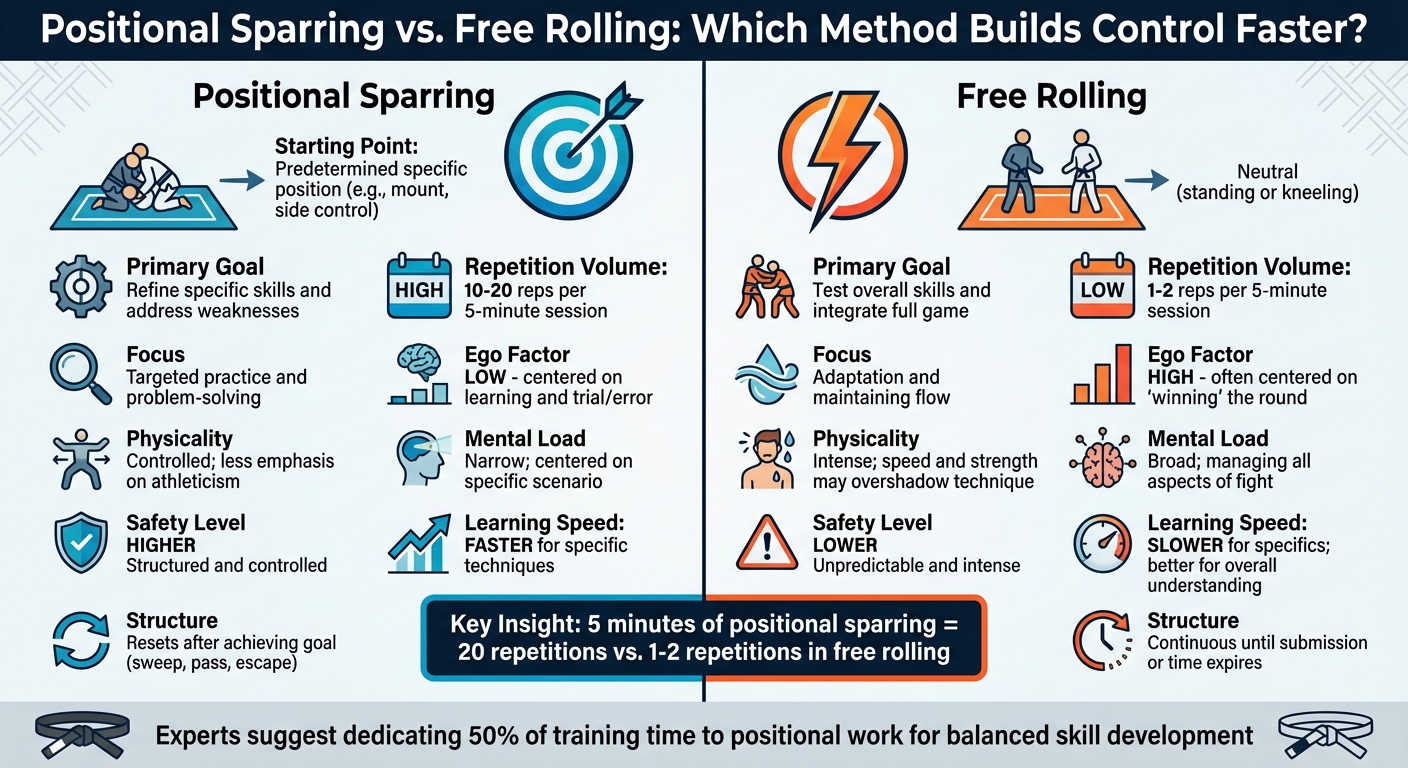
These two training methods in Brazilian Jiu-Jitsu (BJJ) serve different purposes and focus on distinct aspects of your game. Positional sparring focuses on a specific position - like mount or side control - and resets each time a goal is reached. On the other hand, free rolling begins from a neutral stance and continues until submission or the end of the round [4][9][5].
The key difference lies in repetition and focus. Free rolling might only bring you into a weak position once or twice during a session. In contrast, positional sparring allows for 5–10 minutes of concentrated practice, which is ideal for reinforcing muscle memory [3][2]. As Gracie Barra Northridge puts it:
"Positional sparring is for refining a specific skill, while live rolling is for testing and integrating those skills into a complete game" [9].
Pros and Cons of Each Method
Both methods have their strengths and limitations, and each plays an important role in a well-rounded BJJ training program.
Positional sparring is great for sharpening technical skills. It removes the ability to rely on brute force or speed, encouraging proper use of leverage and angles [4]. Since the structure is controlled, it also reduces chaotic movements, making it a safer option [5]. However, it doesn't prepare you for the unpredictable nature of live matches, which require adaptability.
Free rolling, on the other hand, builds mental resilience and sharpens your ability to problem-solve in real time [9]. The downside is that practitioners often stick to their strongest positions, avoiding the areas where they need improvement [11]. RollBliss highlights this balance:
"Positional sparring is meant to complement regular rolling. While it helps refine specific techniques, live rolling is essential for developing adaptability and grappling awareness" [4].
| Feature | Positional Sparring | Free Rolling |
|---|---|---|
| Starting Point | Predetermined specific position [4][9] | Neutral (standing or kneeling) [9][5] |
| Control Improvement | Faster; immediate, repeated feedback [4][5] | Slower; depends on randomness of the roll [2][5] |
| Safety Level | Higher; structured and controlled [5] | Lower; unpredictable and intense [9][5] |
| Skill Balance | Focused on technique; less reliance on athleticism [4] | Athleticism can sometimes overshadow technique [4] |
| Structure | Resets after achieving a goal [4][9] | Continuous until submission or time [9] |
This table highlights the unique strengths of each method, showing how they complement each other in shaping a complete BJJ practitioner.
Comparison Table: Positional Sparring vs. Free Rolling
This table highlights the key differences between positional sparring and free rolling to help shape your training approach.
| Feature | Positional Sparring | Free Rolling |
|---|---|---|
| Starting Point | Predefined position (e.g., back control)[4] | Neutral (standing or kneeling)[9] |
| Primary Goal | Sharpen specific techniques and address weaknesses[9] | Test overall skills and integrate your full game[9] |
| Repetition Volume | High (resets after each attempt)[4] | Low (positions occur sporadically)[2] |
| Focus | Targeted practice and problem-solving[3] | Adaptation and maintaining flow[9] |
| Ego Factor | Low (centered on learning and trial/error)[8] | High (often centered on "winning" the round)[8] |
| Physicality | Controlled; less emphasis on athleticism[4] | Intense; speed and strength may overshadow technique[4] |
| Mental Load | Narrow; centered on a specific scenario[3] | Broad; involves managing all aspects of a fight[9] |
| Downtime | Minimal; quick resets keep you engaged[5] | Can be significant (e.g., neutral standing exchanges)[5] |
In just 5 minutes of positional sparring, you can achieve up to 20 repetitions of a specific escape[4], whereas free rolling might only offer one or two chances to work on the same position[2]. This stark difference demonstrates how focused repetition through positional sparring can dramatically speed up skill development in specific areas.
Table: Positional Sparring vs. Free Rolling
Here's a detailed breakdown of how positional sparring and free rolling differ, emphasizing their unique benefits:
| Feature | Positional Sparring | Free Rolling (Live Rolling) |
|---|---|---|
| Starting Position | Specific/Predetermined (e.g., Back Control) | Neutral (Standing or Kneeling) |
| Primary Focus | Refining specific skills and addressing weaknesses | Testing strategies and integrating skills |
| Repetition Volume | High; quick resets after achieving the goal | Low; positions occur organically during the roll |
| Goal/Outcome | Targeted (e.g., Sweep, Pass, Escape, or Control) | Broad (e.g., Submission or "Winning" the roll) |
| Environment | Controlled and less stressful | Unpredictable and high-pressure |
| Physical Demand | Focused conditioning; less chaotic | Intense; builds timing and reflexes |
| Ego Management | Encourages working on weak areas | May lead to avoiding weaknesses to "win" |
| Technical Focus | High; sharpens specific mechanics | Moderate; emphasizes transitions and flow |
| Injury Risk | Lower (fewer scrambles) | Higher (more dynamic movements) |
| Learning Speed | Faster for specific techniques | Slower for specifics; better for overall understanding |
This comparison highlights how positional sparring zeroes in on technical improvement by forcing you to repeatedly confront and refine weaker areas. The controlled environment allows for focused practice without the distractions of unpredictability. On the other hand, free rolling offers a broader perspective, testing your ability to adapt and flow under pressure. However, it can sometimes mask technical gaps with physicality. Positional sparring removes that crutch, making it a powerful tool for building precise control and addressing deficiencies head-on.
Conclusion
Positional sparring accelerates skill development by offering targeted, high-repetition practice in areas where you're weakest. For instance, instead of attempting a mount escape just once or twice during a typical five-minute round, a focused positional session allows you to drill it 10–20 times [2]. This kind of concentrated practice not only sharpens technique but also helps develop mental calmness and resilience more efficiently than traditional live rolling.
This method also takes ego out of the equation, compelling you to address your vulnerabilities. As BJJ champion Gordon Ryan puts it:
"Most people are trying to win every round because of their egos... situational training forces exposure to neglected positions" [11].
By working from weaker positions, you create a more balanced game that holds up under pressure.
Experts suggest dedicating about 50% of your training time to positional work [8]. Start by identifying one or two problem areas, then schedule 2–3 focused sessions each week, keeping track of your progress in a notebook. This structured approach ensures steady improvement and gives you a competitive edge. If you're looking for an academy that prioritizes this type of training, the Brazilian Jiu-Jitsu Gyms Directory (https://bjjacademyfinder.com) is a great resource. It helps you find high-quality schools across the United States, including in cities like New York, Los Angeles, and Chicago. Look for reviews mentioning "structured rounds", "positional drilling", or "technical focus" to find programs that emphasize precise skill development.
Whether you're a beginner learning to escape tough spots or an advanced practitioner refining subtle adjustments, positional sparring equips you to handle challenges under pressure. Incorporate it into your routine, stay consistent, and you'll see improvements in control that free rolling alone can't deliver.
FAQs
How hard should positional sparring be?
Positional sparring works best when it's intense enough to push you toward learning and refining your skills, but not so overwhelming that it turns into a contest of brute strength. The focus should be on control, technique, and problem-solving rather than raw effort. Adding some resistance is helpful to mimic real-life situations, but the main objective is deliberate practice. By repeatedly working through specific positions, you can sharpen your skills, tackle weaknesses, and keep your training focused and productive.
How do I choose the best positions to start with?
When deciding which positions to focus on during positional sparring, target the areas where you face challenges or want to sharpen your skills. These could include positions like mount, back control, side control, or guard. Repeatedly working on these specific scenarios allows you to fine-tune your techniques and make quicker progress. Starting from positions where you feel less confident not only boosts your offensive abilities but also helps you build stronger defensive skills, speeding up your overall growth.
When should I switch from positional sparring to free rolling?
When you’ve gained enough control and confidence in key positions, it’s time to transition to free rolling. This step lets you apply your skills in a more dynamic and realistic environment. It’s a great way to test your techniques under different conditions and see how prepared you are for the challenges of live rolling.
Related articles
Share this article