
Returning to BJJ: Mental Prep After an Injury
Practical mental strategies to return to BJJ after injury: manage fear, use mindfulness and visualization, set realistic goals, and follow a phased comeback plan.
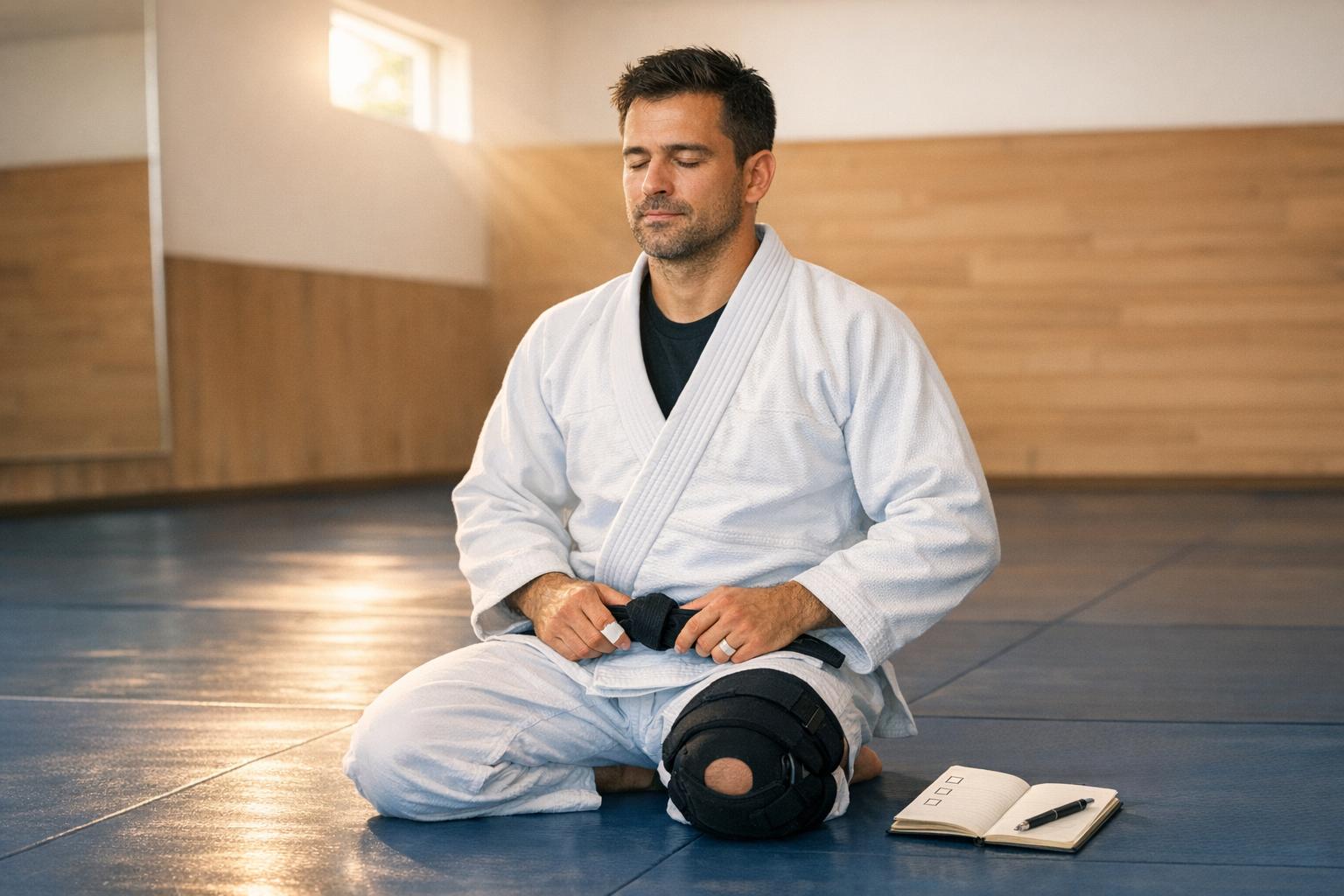
Returning to BJJ: Mental Prep After an Injury
Returning to Brazilian Jiu-Jitsu (BJJ) after an injury isn’t just about physical recovery - it’s a mental challenge too. Fear of re-injury, frustration from lost progress, and the emotional toll of being sidelined can all make your comeback harder. But here’s the good news: with the right mindset and strategies, you can return stronger and more confident.
Key Takeaways:
- Psychological readiness is crucial: Studies show mental recovery predicts a safer return more than physical tests.
- Manage emotions: Stress and anxiety can slow healing. Focus on what you can control - rehab, nutrition, and sleep.
- Gradual return: Start with light drills, then controlled sparring, and ease into full training.
- Use tools like mindfulness and visualization: These can reduce stress, improve focus, and help rebuild confidence.
- Set realistic goals: Track small wins and avoid rushing back too soon.
The goal isn’t just to get back on the mats - it’s to stay there long-term. If you need a fresh start, you can find a BJJ gym nearby that fits your current needs. With patience and the right approach, you can make a safe and steady comeback.
How To Mentally Prepare To Return To BJJ (After Injury)
sbb-itb-d583f1e
Managing Your Emotions During Recovery
Being out of action from BJJ isn’t just a physical challenge - it can weigh heavily on your mind too. Studies show that between 5% and 25% of injured athletes experience emotional distress severe enough to need professional mental health support [10]. Watching your teammates progress while you're sidelined can amplify feelings of isolation. And when you’re finally ready to step back on the mats, the fear of getting hurt again can be overwhelming.
Here’s why this matters: your emotional well-being directly impacts how your body heals. Stress and anxiety can make it harder for your body to rest and recover. Dr. Matthew Sacco from Cleveland Clinic puts it bluntly:
"We need to do a better job of addressing mental as well as physical aspects of athletic injuries. Then we stand a better chance of getting people the help and support they need." [3]
Accepting the Recovery Process
Recovery isn’t a setback in your BJJ journey - it’s a necessary part of it. It’s a chance to address nagging issues like a sore neck, a tweaky elbow, or a clicking knee [6].
Five-time BJJ World Champion Bernardo Faria knows this firsthand. In October 2022, he opened up about breaking his foot just two days before ADCC 2015. Mentally, he felt ready to train, but his body wasn’t there yet, creating what he called a “trap.” To avoid making things worse, he eased back into training by attending only three classes in his first week, rolling with trusted partners, and focusing on strength training to stabilize his joints before diving into intense competition prep [6]. His takeaway?
"It's better to sustain training 12 months at 90% intensity, then it is to train 4 months at 120%, get injured and be out many months." [6]
Rushing back too soon often leads to re-injury, which only prolongs your time off the mats [7]. Instead, focus on what you can control: sticking to your rehab plan, putting in consistent effort, eating well, and getting quality sleep [1][4]. While you can’t change the injury or the time lost, you can control how you approach your recovery.
Once you’ve accepted the process, the next step is tackling the fear of getting injured again.
Dealing with Fear of Getting Injured Again
Fear of re-injury is completely normal, but if left unchecked, it can hold you back. Your brain might misinterpret normal sensations as warning signs, creating tension and spiraling thoughts [8]. This mental loop can slow your recovery or even make you hesitant during training, which ironically increases your risk of getting hurt [8].
The antidote? Replace emotional reactions with objective facts. When anxiety rises, remind yourself: “My doctor cleared me,” “I’ve completed my rehab,” and “My coach and PT believe I’m ready” [8]. Dr. Julia Kim from HSS highlights the emotional toll injuries can take:
"Injuries can take a toll on our thoughts and emotions, sometimes even more than the physical injury to our body." [8]
One tool to measure your readiness is the I-PRRS Scale (Injury-Psychological Readiness to Return to Sport). Rate your confidence from 0 to 10 in areas like competing without pain, giving full effort, and trusting your body to handle the demands of grappling [2]. Research shows that mental readiness often predicts a smoother return and lower re-injury risk better than physical tests alone [2].
Just as you ease back physically, take the same approach mentally. Start with controlled, technical rolls with partners who understand your injury and will train safely with you [5][6]. Be upfront with your instructor and training partners about your limitations - it’s not a sign of weakness, it’s smart training [5]. Shift your focus to process goals, like nailing your warm-up or perfecting your form in drills, instead of performance outcomes like winning rolls [1][9].
Using Mindfulness to Build Mental Strength
Mindfulness can play a powerful role in speeding up recovery and strengthening mental resilience. It not only helps you bounce back but also prepares your mind for a confident return to training. Studies have shown that mindfulness practices can lower cortisol levels - the stress hormone - and improve cognitive functions like memory, focus, and mental flexibility. This can help you manage concerns about losing your technique or risking re-injury during recovery [11].
Regular mindfulness practice also keeps you fully present during rehabilitation. Instead of mentally jumping ahead to full-contact sparring, it encourages you to focus on each recovery exercise. BJJ Performance Coach Kieren Lefevre highlights this connection:
"Meditation has been shown in studies to reduce stress and cortisol levels (the stress hormone), the lower your cortisol, the lower your inflammation, the lower your inflammation the better your recovery therefore meditation = recovery." [13]
Now, let’s dive into how controlled breathing techniques can help you stay calm and focused.
Breathing Exercises for Calm and Focus
Your breath is a powerful tool for calming your nervous system when anxiety starts to creep in. Practicing controlled breathing before returning to training can help you manage mental energy and prevent overexertion. Beyond its calming effects, breath control also improves cardiovascular efficiency by enhancing CO₂ thresholds and oxygen utilization - key benefits for recovery [6][12].
To incorporate this into your routine, try focusing on slow, deep breaths during light drills. This practice helps you stay composed and grounded in the present, reducing the tendency to spiral into "what if" thoughts about re-injury. Alongside breathing techniques, meditation can further sharpen your mental clarity.
Meditation for Mental Clarity
Daily meditation is a great way to build mental resilience during recovery [11][12]. Start with 15–20 minute sessions to establish a consistent routine without feeling overwhelmed. If simple breath-focused meditation feels too open-ended, try techniques that involve multiple points of focus, such as visualizing energy centers or using chants. These methods can help keep your mind engaged [12].
The goal isn’t to block out negative thoughts but to change how you respond to them. When frustration or doubt arises, acknowledge those feelings without judgment. Then, shift your focus to what you can control - your rehab exercises, nutrition, and sleep habits. Over time, this mental shift strengthens values like discipline and perseverance, helping you maintain a "never give up" mindset as you work toward a safe and steady return to training [1][11][12].
Visualizing Your Comeback
Once you've built mental resilience through mindfulness, visualization becomes a powerful tool to prepare for your return. Even when you're off the mats, mental imagery can help keep your skills sharp. When you picture yourself performing movements, your brain activates the same neural pathways as it would during the actual action. This process helps preserve muscle memory. As Sport Psychology Consultant Eli Straw explains:
"When you imagine something, your mind does not simply see this as an image... your brain fires in the same way during a visualization session as it does when the action is actually being performed." [15]
To make the most of this practice, keep your sessions brief - 5 to 10 minutes works well to maintain focus without overloading your mind. Start with 2–3 minutes of deep, steady breathing to settle your thoughts and prepare for visualization.
Mentally Rehearsing Techniques
Visualization isn't just about imagining movement; it can deepen your technical understanding in ways physical training alone can't. PhD candidate and BJJ blue belt Itamar Shatz highlights how mental practice enhances motor learning, stating it "promotes the cognitive adaptation process during motor learning, leading to more elaborate representations than physical practice only" [16].
Stick to techniques you've already mastered. Mentally practicing moves you haven't physically learned could reinforce incorrect habits. Pick specific scenarios to visualize, such as passing guard or escaping side control. Focus on details like hand placement, weight distribution, hip movement, and timing. To gain a complete understanding, alternate between seeing the action from your own perspective and imagining it from an external viewpoint [16].
Before starting, review instructional videos or articles to reinforce the technique in your mind. Then, use visualization to maintain your muscle memory while your body heals [1].
The next step is to address any anxiety about returning to training by picturing a safe and gradual comeback.
Imagining a Safe and Gradual Return
Fear of re-injury can be a significant mental hurdle. Studies show that psychological readiness often determines whether athletes return to their previous performance levels, sometimes even more than physical recovery does [14]. Research on ACL injuries, for example, indicates that mental preparedness can be a stronger predictor of success than physical tests [2].
Instead of jumping back into intense sparring, visualize a gradual and controlled return. Imagine training with trusted partners who roll at a steady, technical pace. This methodical approach has been used successfully by athletes like Bernardo Faria, who emphasizes the importance of choosing reliable training partners [6].
When visualizing, don't just picture the movements - immerse yourself in the emotions you want to feel. Imagine confidence, calmness, and executing each technique smoothly and without pain. Many athletes report feeling less anxious and more self-assured when they include guided imagery as part of their recovery [14]. This emotional rehearsal helps lay the groundwork for a strong and successful return to the mats.
Setting Realistic Goals for Your Return
Now that your mindset is in the right place, it’s time to focus on setting practical and safe goals for your return to training. These objectives should align with your current condition and help you rebuild your skills without rushing the process. Dr. Mike Piekarski, a Doctor of Physical Therapy, emphasizes the risks of pushing too hard too soon:
"If an athlete returns too early there is a risk of re-injury or a secondary injury as the athlete alters their movement patterns to protect the initial injury." [18]
Recovery timelines vary widely depending on the type of injury. For example, Grade 1 strains may heal within 0–2 weeks, while Grade 2 sprains can take anywhere from 3 weeks to 3 months. Bone injuries often require 5 weeks to 3 months, and ligament grafts may need 3 months to 2 years for full recovery. [18]
Starting Small and Focusing on Progress
The key to a successful return is starting small and prioritizing consistency. Begin with solo drills to rebuild muscle memory before involving a partner. [19] As The Jiu-Jitsu Therapist advises:
"One of the pieces of advice I give out is to 'limit the variables.' This basically means to decrease any external factors out of my control that can increase likelihood of re-injury." [19]
Consider attending beginner or fundamental classes to ease back into training at a manageable pace. [17] For your first 3–5 sessions, focus exclusively on drills and techniques rather than live sparring. [21] When you’re ready to roll, try positional sparring using the "pass and defend" method. This involves stopping the round after a sweep or submission, allowing you to safely practice BJJ-specific movements. [19]
Brown Belt and Exercise Scientist Samuel Spiegelman offers a long-term perspective:
"Your goal is not to train BJJ for a month. Your goal is to train for years." [17]
Tracking Your Progress
Success isn’t just about performance - it’s about the small, controllable steps you take every day. Focus on factors like regular attendance, completing therapy exercises, and leaving sessions with energy. [1] Keep a weekly journal to track your progress. Note one physical improvement (such as better range of motion), one mental challenge you handled well, and one accomplishment that made you proud. [1] Aim for an 80–90% success rate on your daily checklist, which might include rehab exercises, proper nutrition, and adequate rest. [1]
Typically, it takes 4–6 weeks of consistent training to regain pre-injury fitness levels. [21] Pay attention to how your body responds during warm-ups, especially when testing movements related to your injury, like posting for a sweep. [17] If you feel anxious or uneasy about training with certain partners, it may be a sign to adjust your intensity or take a step back. [20]
These measurable, step-by-step goals will serve as the backbone of your recovery plan, helping you return to training with confidence and control.
Creating a Step-by-Step Comeback Plan
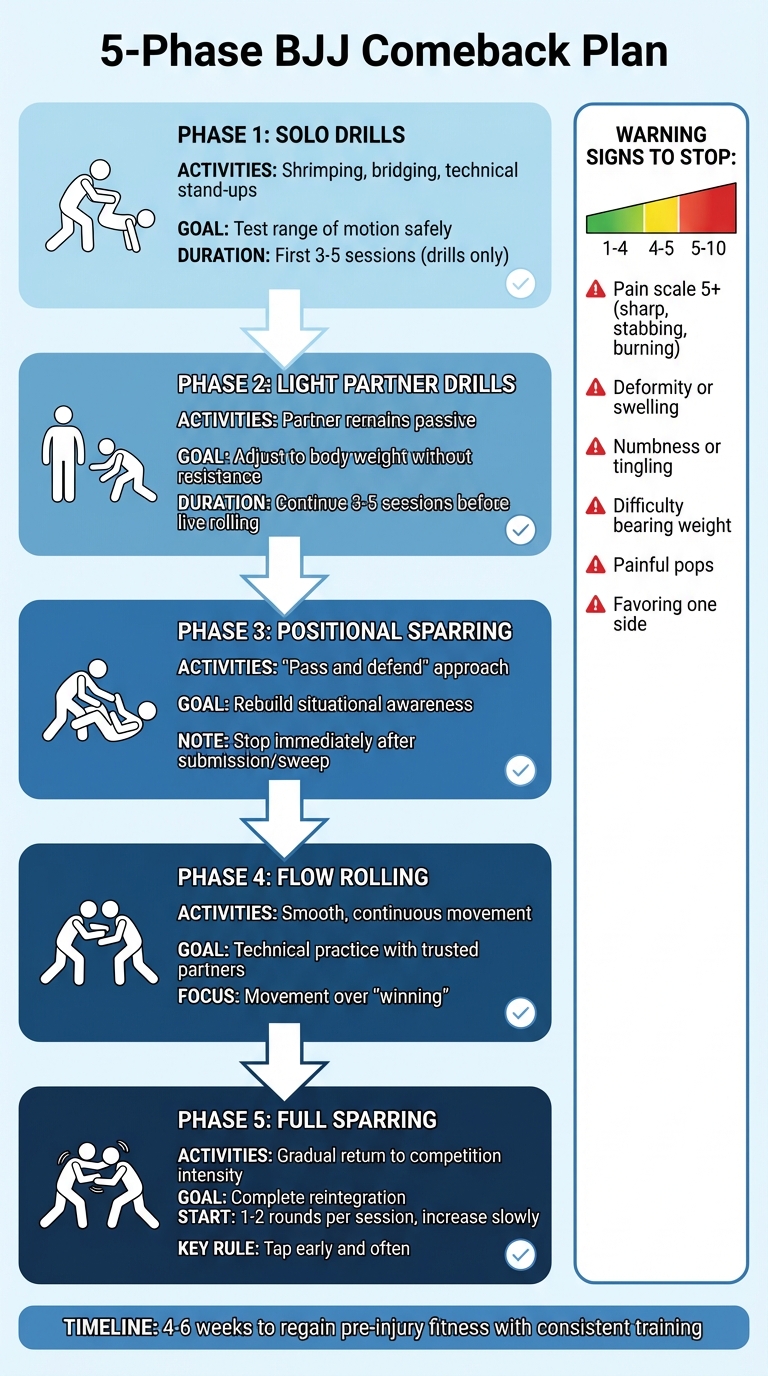
5-Phase BJJ Comeback Plan After Injury
Once you've built up your mental resilience, it’s time to create a structured comeback plan to ease your way back into training. This five-phase approach is designed to help you recover at a steady pace, moving from independent exercises to full-intensity training. Each phase is a stepping stone, ensuring your body and mind are prepared for the next level.
Start with Light Drills
Phase 1 begins with solo drills like shrimping, bridging, or technical stand-ups. These movements help you test your range of motion and ensure you can move safely before introducing any partner work.
When you’re comfortable with solo drills, progress to Phase 2. Here, you’ll incorporate light partner drills. Your partner should remain passive, allowing you to focus on technique and adjust to handling another person’s body weight without the unpredictability of live resistance. Stick to drilling for your first 3 to 5 sessions before attempting any live rolling [21].
Move to Controlled Sparring
In Phase 3, introduce positional sparring. Use a "pass and defend" approach, focusing on specific positions like guard passing, sweeps, or escapes. Stop the drill immediately if a submission or sweep is completed. This controlled environment helps you rebuild situational awareness without the intensity of full sparring.
Phase 4 involves flow rolling with trusted partners. The goal here is smooth, continuous movement rather than "winning." Select partners who are technical and mindful - those who respect your recovery process and avoid risky, sudden movements.
Pay Attention to Your Body
Your body will let you know if you’re pushing too hard. Use a 1–10 pain scale to gauge your limits: mild discomfort in the 2–4 range might be acceptable during recovery, but anything sharp, stabbing, or burning at level 5 or above is a sign to stop. Typical training soreness feels like muscle fatigue that eases with light movement, while localized pain or joint instability means you should return to an earlier phase.
Be alert for serious warning signs like deformity, numbness, tingling, difficulty bearing weight, or painful pops. Dr. Mike Piekarski emphasizes:
"If an athlete returns too early there is a risk of re-injury or a secondary injury as the athlete alters their movement patterns to protect the initial injury." [18]
If you notice yourself favoring one side or avoiding certain movements, it’s a clear indication that you’re not ready to progress.
Ease Back into Full Sparring
Phase 5 is where you gradually reintroduce full sparring. Start with just one or two rounds per session and slowly increase as your body adapts. Tap early and often - don’t wait for submissions to fully lock in, especially in positions that could stress your recovering injury [20][17]. Keep the intensity moderate to reduce the risk of setbacks and maintain long-term consistency in your training.
Staying Connected to BJJ During Recovery
Staying mentally engaged with Brazilian Jiu-Jitsu (BJJ) during recovery not only keeps you motivated but also helps sharpen your technical understanding. Staying connected to your academy and community can make the transition back to training smoother.
Learning Through Observation
Even if you can’t train, showing up at the academy is still valuable. Watching from the sidelines allows you to stay connected with teammates while picking up on technical details that might go unnoticed during active training. For example, you can observe how advanced practitioners transition between positions, create angles, or recover from bad spots [22][23].
"By continuing the ritual of coming to the academy you will not fall into the habit of avoiding going to begin with" [23]
Take advantage of your downtime by diving into digital resources. Instructional videos, competition footage, and technique breakdowns on platforms like YouTube can be incredibly helpful. Stephan Kesting, founder of Grapplearts, highlights the value of this approach:
"If you used to train 6 hours a week on the mat then you might be surprised at what studying the art on your computer for just 3 hours a week might accomplish" [7]
Podcasts like BJJ Mental Models or the Shintaro Higashi Show are also great tools. They offer insights into strategy and technique that can deepen your understanding, even during your commute or downtime [23].
Identifying Weaknesses and Planning Improvements
Recovery time is an opportunity to reflect on your game and identify areas for growth. Reviewing footage of past sparring sessions or competitions can reveal patterns - like getting swept from half guard or struggling with guard retention under pressure. Use this time to focus on specific weaknesses. For instance, dedicate a few hours a week to studying sidemount escapes or guard retention concepts so you’re ready to address them when you return [7].
Interestingly, setbacks can lead to breakthroughs. Roberto "Gordo" Correira famously developed modern offensive half-guard after an ACL injury limited his ability to play a conventional guard. His innovation reshaped the sport, proving that downtime can lead to significant technical growth [7].
Exploring New Gyms or Training Opportunities
As you near the end of your recovery, finding the right environment to ease back into training is essential. Look for academies with beginner-friendly programs and a culture of controlled rolling. These settings emphasize safety and technical precision, which are ideal when returning from an injury. Bernardo Faria, a five-time BJJ World Champion, shares his approach:
"I restarted training and I just trained 3 classes during the week and I just rolled with the training partners I trusted to train in a controlled manner" [6]
Resources like the Brazilian Jiu-Jitsu Gyms Directory can help you locate academies across the U.S. with detailed program descriptions, instructor credentials, and reviews. This makes it easier to find a gym that aligns with your recovery needs. Be sure to communicate your injury status and limitations to instructors and training partners so they can accommodate you appropriately [17][24].
Conclusion
Getting back to BJJ after an injury involves more than just physical recovery - your mental state plays a huge role too. Studies suggest that psychological readiness can be a stronger predictor of successful returns and reduced re-injury risks than physical tests alone [2]. Your confidence, mindset, and emotional control directly impact how smoothly you rejoin training.
This guide outlined key strategies like managing emotions, practicing visualization, setting achievable goals, and easing back into training. These steps are crucial for regaining both your physical abilities and mental confidence. As Krista Stryker, founder of 12 Minute Athlete, reminds us:
"This phase is not wasted time. It's not a detour. And it doesn't erase the work you've already put in." [1]
Remember, injury recovery is a normal part of the BJJ journey - not a setback or failure. Every practitioner encounters challenges. Focus on what you can control: staying consistent with rehab, maintaining a positive attitude, and choosing training partners wisely. Let go of the rest.
As 5x BJJ World Champion Bernardo Faria wisely advises, "It’s better to sustain training 12 months at 90% intensity, then it is to train 4 months at 120%, get injured and be out many months." [6]
Your ultimate goal isn't just to get back on the mats - it’s to stay there for the long haul. Patience, steady progress, and mental toughness will always outweigh the urge to rush back too soon.
FAQs
How do I know if I’m mentally ready to roll again?
Returning to Brazilian Jiu-Jitsu (BJJ) after a break requires careful attention to your mental state. Ask yourself: Do you feel confident, or is there hesitation or nervousness about getting back to rolling? Start slow. Begin with technique drills and light partner exercises before easing into sparring when you feel ready.
It's also crucial to communicate with your instructors and training partners. Let them know about any limitations you might have. Set achievable goals for yourself, prioritizing technique over intensity. Most importantly, trust the recovery process and pay attention to what your body is telling you - there's no need to rush.
What should I do if fear of re-injury takes over in training?
If the fear of re-injury starts to creep in, take things slow and ease back into training at a pace that feels right for you. Talk openly with your instructors and training partners about your concerns - they can help create a safer and more supportive environment. Prioritize refining your technique and maintaining control over pushing for intensity. Setting small, achievable goals can also help you rebuild confidence step by step. Preparing mentally and keeping your expectations in check are key to overcoming fear and making your return to the mats both safe and steady.
How can I pick safe training partners and a safe gym after injury?
When selecting training partners, go for those who prioritize safety, understand your current condition, and are willing to adjust their resistance levels to help you avoid re-injury. Start with light or even no-resistance drills to rebuild your confidence and refine your technique gradually. Seek out gyms that feature qualified instructors, enforce proper safety protocols, and create a supportive atmosphere. It’s also a good idea to consult your coach or physical therapist - they can guide you to a gym that best suits your recovery requirements.
Related articles
Share this article