
Ultimate Guide to BJJ Mental Preparation
Mindset shapes every roll — daily mental training in visualization, breathing, SMART goals, and journaling improves BJJ performance.
Ultimate Guide to BJJ Mental Preparation
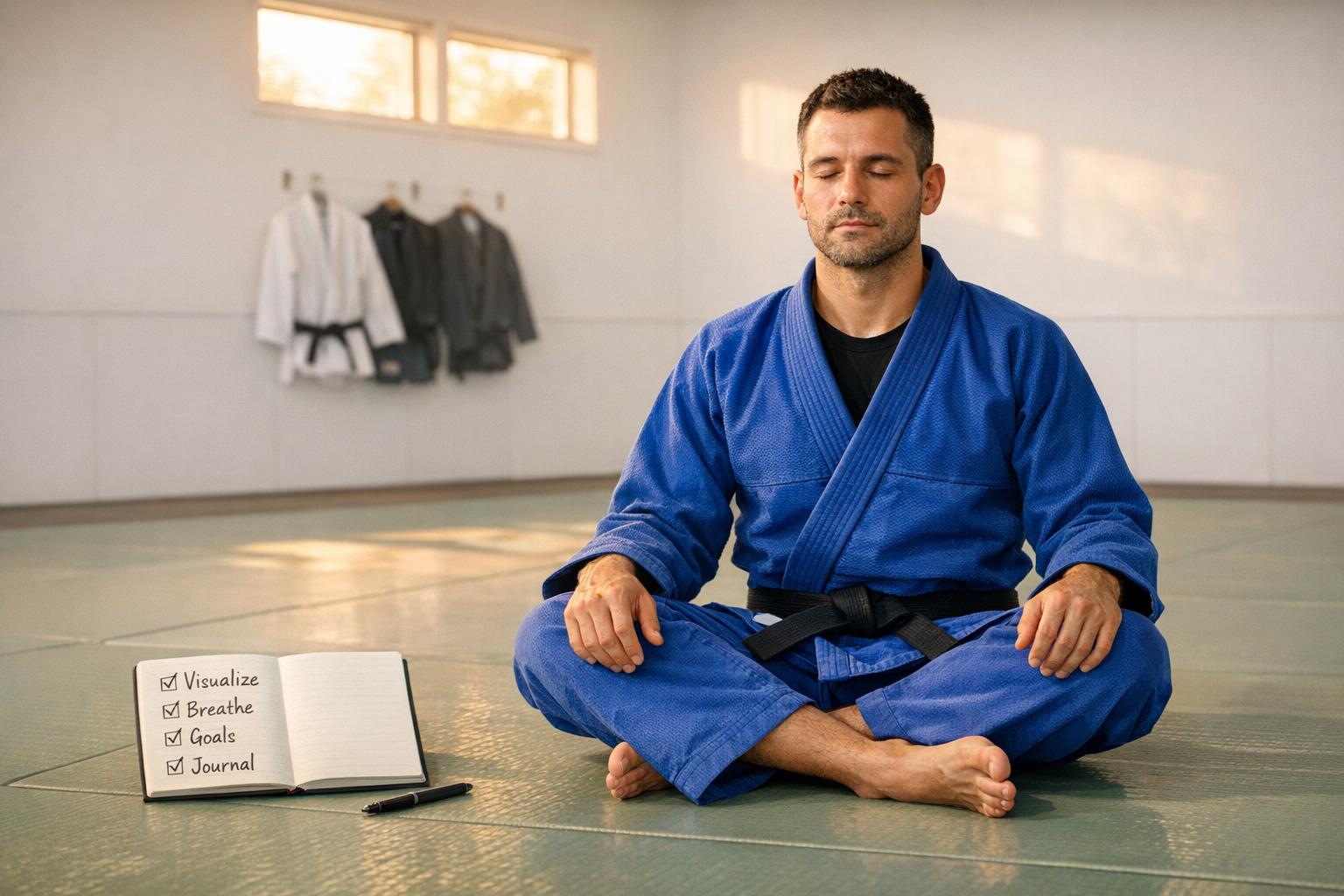
Your mindset can make or break your performance in Brazilian Jiu-Jitsu (BJJ). While physical training builds your skills, mental preparation ensures you can use them effectively under pressure. Here's how you can sharpen your mental game for competition and training at your local gym:
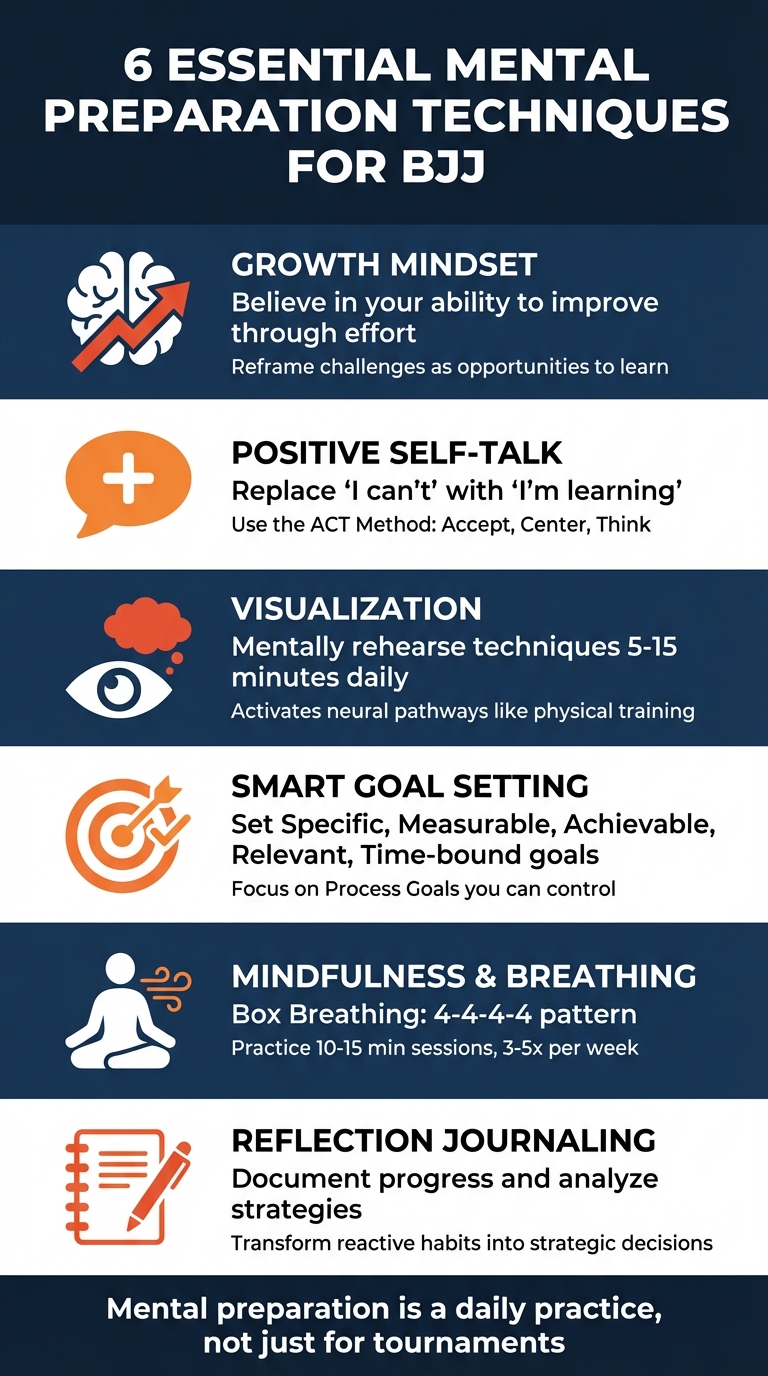
- Growth Mindset: Believe in your ability to improve through effort. Reframe challenges as opportunities to learn.
- Positive Self-Talk: Replace negative thoughts like "I can't" with constructive ones like "I'm learning."
- Visualization: Mentally rehearse techniques and scenarios to activate neural pathways and build confidence.
- Goal Setting: Use SMART goals (Specific, Measurable, Achievable, Relevant, Time-bound) to stay focused on progress.
- Mindfulness & Breathing: Manage stress with techniques like box breathing and meditation to stay calm and present.
- Reflection: Use a training journal to analyze your progress and refine your strategies.
Mental preparation isn’t just for tournaments - it’s a daily practice that builds resilience and focus. By integrating these techniques into your routine, you’ll perform with clarity and confidence, both on and off the mat.
6 Essential Mental Preparation Techniques for BJJ Athletes
Rafael Lovato Jr Interview - Mental Preparation for Jiu Jitsu Competitions
sbb-itb-d583f1e
Developing Mental Strength for BJJ
Mental preparation is a cornerstone of success in Brazilian Jiu-Jitsu (BJJ), but it’s not just about getting psyched up before a match. True mental strength is built through how you handle both training and setbacks. The difference between someone who walks away after a tough roll and someone who comes back stronger lies in their mindset. By seeing challenges as opportunities to grow, you can unlock untapped potential. Let’s dive into how adopting a growth mindset, tackling negative self-talk, and building confidence through consistent training can sharpen your mental edge.
Adopting a Growth Mindset
A growth mindset is all about believing that your abilities can improve with effort, while a fixed mindset assumes that talent is set in stone [7][9]. For instance, someone with a fixed mindset might blame their struggles on size differences, while a growth mindset asks, "How can I adjust my strategy to overcome a larger opponent?" This perspective turns obstacles into stepping stones. Instead of saying, "I'm terrible at guard", you can reframe it as, "I need to put more time into improving my guard." This shift not only prevents stagnation but also helps you see stress as a chance to grow, not a roadblock [9][11].
Stopping Negative Self-Talk
Even with a growth mindset, the way you talk to yourself during training can make or break your progress. Negative thoughts like "I'm not good enough" can quickly become self-fulfilling prophecies. The key is to catch these thoughts and replace them with constructive ones. For example, swap "I can't do this" with "I’m learning, and I’ll get there."
A practical tool for this is the ACT Method:
- Accept your feelings without judgment.
- Center yourself with confident body language.
- Think using positive, prepared self-talk.
This method shifts your focus from doubt to execution, keeping you grounded and ready to act [6].
Building Confidence Through Training
Confidence doesn’t come from wishful thinking - it’s earned through preparation.
"Preparation tells your nervous system: 'I'm ready. I did the work.'"
– The BJJ Mental Coach [4]
This preparation minimizes the shock factor of competition. Confidence grows from small daily victories - whether it’s defending against a submission, pulling off a sweep, or staying calm under pressure. Training with unfamiliar partners or visiting different academies can also test and strengthen your adaptability. If you’re looking to expand your training experiences, the Brazilian Jiu-Jitsu Gyms Directory (https://bjjacademyfinder.com) is a great tool for finding academies that offer new challenges.
Visualization and Goal Setting
Mental rehearsal taps into the same neural pathways as physical training. When you visualize performing a technique, your muscles respond as if you're actually executing it. Rickson Gracie, a legendary figure in BJJ, once described this process:
"It's the most beautiful movie, and every time I relive it I create images and nuances that I want to experience." [13]
By mimicking physical practice, visualization strengthens your grasp of BJJ techniques.
Visualization Techniques for Competition
Effective visualization goes beyond just picturing a win - it involves engaging all your senses. Imagine the texture of your gi, the referee’s voice, the sounds of the crowd, and even the smell of the mat. Using a first-person perspective can immerse you fully into the moment, making the experience feel real. Muhammad Ali called this process "future history", and fighters like Conor McGregor have used it to mentally rehearse every detail, from their walkout to their winning move.
Set aside 5–15 minutes daily for mental rehearsal, preferably in the morning. Focus on visualizing the step-by-step execution of your game plan rather than just the final victory. Pair this practice with box breathing (inhale for 4 seconds, hold for 4 seconds, exhale for 4 seconds, hold for 4 seconds) to calm your mind and sharpen your focus. This kind of detailed imagery helps you create clear and realistic goals.
Setting SMART Goals
Turning your vision into actionable steps is where SMART goals come in. The framework - Specific, Measurable, Achievable, Relevant, and Time-constrained - provides a solid structure for goal-setting. Divide your goals into three categories:
- Outcome Goals: Focused on results, like winning your division.
- Performance Goals: Centered on specific skills, such as maintaining top control.
- Process Goals: Based on actions you can control, like attending every training session for two months.
Process goals are especially effective because they keep the focus on what you can control, rather than external factors. For instance, instead of saying, "I want to get better at BJJ", aim for something concrete like, "Drill the tripod sweep 50 times every Tuesday for six weeks." You can also refine your skills during sparring by setting rolling constraints - like avoiding guard pulls or letting opponents mount you to practice escapes.
Structured goals not only improve your technique but also help you manage the stress that comes with competition. Studies show that all BJJ competitors experience their highest stress levels right before stepping onto the mat, making goal-setting a crucial tool for staying composed [6].
Documenting your goals and tracking your progress can solidify your mental training.
Using a Training Journal
A training journal is a powerful tool for turning reflection into progress. Instead of just noting wins or losses, focus your entries on Process Goals - specific, controllable actions like drilling techniques or improving transitions. Use the journal to map out your "A-game" strategy and analyze your reactions to common opponent moves. Over time, this practice can transform reactive habits into strategic decisions.
After tough training sessions or competitions, reflect on how you handled challenges. This kind of psychological preparation - typically done in 10-to-15-minute sessions, three to five times a week - can significantly enhance your mental game. Many top-level athletes use detailed mental strategies, and journaling is a key step in developing that level of preparation [6].
Mindfulness and Stress Management
Mindfulness and stress management are essential tools to sharpen your competitive mindset. Feeling nervous before a match is a sign that you care deeply about your performance. The key is learning to channel those nerves effectively. As The BJJ Mental Coach explains:
"The goal is not to eliminate [nerves]… The goal is to stay regulated enough to make good decisions." [4]
Using mindfulness techniques and breathing exercises can help you manage pre-match anxiety and maintain focus when it counts.
Mindfulness Practices for Staying Present
Staying present is one of the most effective ways to calm a racing mind before stepping onto the mat. A simple yet powerful technique is present-moment anchoring. Close your eyes and focus on the sensation of your breath entering and leaving your body. Pay attention to the details around you - the texture of your gi, the sounds of your surroundings, or the feel of the mat under your feet [10]. This practice keeps you grounded, preventing your mind from wandering into "what if" scenarios about your opponent or the match outcome.
Between matches, short 5-to-10-minute mindfulness sessions can help reset your nervous system and conserve mental energy [15]. Find a quiet spot, sit comfortably, and focus on your breathing. When your thoughts stray, gently guide your attention back to your breath. This habit reduces emotional exhaustion during long competition days and helps you stay sharp across multiple matches [2].
Another powerful mindset shift is to reframe anxiety as excitement. Physiologically, anxiety and excitement create similar symptoms - like a fast heartbeat and heightened senses [3]. Instead of interpreting these sensations as fear, view them as your body preparing to perform. This mental adjustment can transform nervous energy into a performance boost.
Focus on what you can control: your effort, your attitude, and your strategy. Worrying about factors outside your control, such as your opponent’s skill level or the judges’ decisions, can drain your mental energy and hurt your performance [15][10]. Direct your attention to what’s within your power, and let go of the rest.
Breathing Exercises for Calmness
Controlled breathing is a simple yet effective way to calm your mind and body. It activates your relaxation response while suppressing the "fight or flight" reaction [16][17]. Deep nasal breathing helps oxygenate your brain and muscles, improving your decision-making under pressure [17][18]. The best time to practice these techniques is during regular training, especially when you’re feeling fatigued or frustrated. This way, they’ll become second nature during competition [4][2].
Here are a few breathing techniques to try:
| Breathing Technique | Protocol | Primary Benefit |
|---|---|---|
| 4-7-8 Breathing | Inhale for 4 seconds, hold for 7 seconds, exhale for 8 seconds | Quickly triggers relaxation and reduces anxiety [16][14] |
| Box Breathing | Inhale for 4 seconds, hold for 4 seconds, exhale for 4 seconds, hold for 4 seconds | Promotes focus and steadiness under pressure [2][18] |
| Psychological Sigh | Take 2 short inhales through the nose, followed by a long exhale through the mouth | Instantly calms the nervous system [15] |
The Psychological Sigh is especially helpful when you’re feeling overwhelmed. Perform two quick inhales through your nose, then a long exhale through your mouth. Repeat this one to three times to quickly settle your nerves [15].
Box Breathing, often used by elite athletes and military personnel, follows a 4-4-4-4 pattern: inhale, hold, exhale, and hold, each for four counts [17][2][18]. This technique helps you stay calm and focused, even under intense pressure.
For pre-competition nerves, try 4-7-8 Breathing. Inhale quietly through your nose for four seconds, hold for seven seconds, and exhale audibly through your mouth for eight seconds. Repeat this cycle four times to activate your parasympathetic nervous system and promote relaxation [16][14]. Research even suggests that deep breathing can aid in retaining newly learned motor skills, making it a valuable addition to both mental and physical preparation [16].
Pair these breathing exercises with short meditation sessions to further enhance your focus.
Meditation for Focus and Relaxation
Meditation is a proven way to reduce cortisol levels and sharpen your focus before competing [19]. A simple mindfulness meditation practice involves sitting quietly for 5 to 10 minutes, closing your eyes, and focusing on your natural breath. When your thoughts wander, gently bring your attention back to your breathing without judgment [15]. This helps you stay grounded and prevents emotional reactions that could cloud your judgment [19].
Incorporate meditation into your routine by starting with short pre-class sessions to center your mind and using post-training reflections to turn setbacks into learning opportunities [19]. Techniques like Samatha (concentration) and Vipassana (insight) can deepen your mental clarity and focus over time [19]. Apps like Headspace, Calm, Insight Timer, and Waking Up are also popular tools among BJJ athletes to build a consistent meditation habit [15].
Meditation complements physical training by activating the same neural pathways used during practice. This mental rehearsal can be a powerful supplement to time spent on the mat [2]. Beginners often need 8 to 12 weeks to prepare mentally and physically for competition, while experienced athletes may require 4 to 6 weeks [2]. By committing to meditation, you’ll develop the mental resilience to perform under pressure and stay composed when it matters most.
Adding Mental Training to Daily BJJ Practice
Mental preparation isn’t just for competition week - it’s something to integrate into your daily routine, just like drilling or sparring. Techniques like visualization and mindfulness can become part of your regular practice, helping you build the mental toughness needed for high-pressure situations. Research suggests that short Psychological Skills Training sessions - 10 to 15 minutes, 3 to 5 days a week - can make a noticeable difference in mental resilience [6]. By making these exercises a habit, you’ll develop the mental reflexes to perform under stress.
Mental Drills During Sparring
Live sparring is the perfect time to sharpen your mental edge. Instead of rolling out of habit, set a clear intention for each session. Maybe you’ll work on your "A-game" plan or focus on responding to specific positions like closed guard or side control [4].
Another effective strategy is positional simulation. Instead of starting every round from the knees, begin in scenarios you’re likely to encounter in competition, like standing exchanges or specific guard positions. This helps mimic the intensity and structure of tournament matches, which usually last 5 to 8 minutes depending on belt level and age group. Training with different partners also helps you adapt to the unpredictability of facing unfamiliar opponents [2].
When fatigue sets in, use tactical breathing to stay calm and focused [2]. You can also apply the ACT method (Accept, Center, Think) to stay mentally sharp during tough positions [6].
As The BJJ Mental Coach puts it:
"Most competitors don't lose because they don't know the move. They lose because their mind gets in the way of the move." [4]
To simulate tournament pressure, try sparring under strict time limits or with a teammate acting as a referee. Research shows that stress levels peak right before competition, with cortisol levels significantly higher than during regular training [6]. By recreating that intensity in practice, you’ll feel more prepared when it’s time to compete. These drills can seamlessly fit into your mental training routine.
Using Affirmations and Positive Reinforcement
Affirmations are a powerful way to shift your mindset. Instead of dwelling on negatives like "my guard is terrible", focus on specific, achievable goals [12]. Research from Stephanie L. Stolz at Missouri Western State University shows that positive reinforcement boosts confidence and reduces anxiety, while negative reinforcement can actually hurt performance [12].
Use affirmations that emphasize actions rather than outcomes. For example: "I am going to sweep someone today", "I trust my training", or simply, "I can and I will" [2][12]. Chewy, founder of Chewjitsu, explains it well:
"If you step on the mat believing you can do something and go after it, you'd be surprised what you can do. If you step on the mat defeated mentally and convinced you're not going to be successful, then you're probably not." [12]
The A.C.E. Framework - Actions, Concentration, and Effort - helps you focus on what you can control, keeping your mindset steady regardless of physical performance [4]. Before training, try adopting confident body language, like power poses, to influence your mood and even your hormone levels. Over time, this practice can rewire your mental state, making confidence feel second nature [12].
Reflection After Training Sessions
Reflection is where the real mental growth happens. Use the cooldown period after class to go over what you’ve learned, visualizing techniques to solidify them in your memory [5].
After each session, take a moment to evaluate both your successes and areas for improvement. Use these insights to set specific goals for your next session. This keeps you in a growth mindset, turning every training - good or bad - into an opportunity to learn [1]. Reflecting on moments of frustration or mental lapses also helps you identify emotional triggers and patterns that affect your performance [8].
If you have a rough session, the ACT method can help: Accept your feelings, Center yourself with confident posture, and Think positively about what you can control [6]. Honest self-assessment builds the trust in yourself needed to compete with clarity and decisiveness [4]. As Angela R. Taylor, a BJJ coach, wisely notes:
"By celebrating progress, you maintain a growth mindset and stay motivated for the next challenge." [1]
Seek feedback from coaches and teammates regularly. This constructive input not only helps you spot technical weaknesses but also builds your confidence. When combined with consistent reflection, this feedback loop turns your daily training into a mental boot camp, preparing you for the challenges of competition.
Conclusion: Key Takeaways for BJJ Mental Preparation
Throughout this guide, we've seen how mental preparation in Brazilian Jiu-Jitsu requires consistent effort, combining awareness, planning, and emotional control [4][6]. Studies suggest that nearly 90% of people overlook the importance of both physical and mental preparation, often leading to challenging competition experiences [21].
The best strategy blends techniques like arousal regulation, visualization, and process-focused goal setting. For instance, try box breathing to keep adrenaline in check [2], spend 10–15 minutes visualizing success 3 to 5 times a week [6], and focus on executing your game plan rather than obsessing over the outcome.
Building self-trust is essential for confidence in competition. This trust grows through regular technical practice and honest self-evaluation [4]. Concentrate on what you can control - your actions, focus, and effort - while letting go of external factors like your opponent's skill level or referee decisions [20][21]. This mental shift reduces unnecessary pressure, allowing you to perform with greater freedom.
By consistently applying these techniques, you can strengthen your mental resilience. Whether you're using the ACT method during tough sparring sessions, practicing affirmations before stepping on the mat, or reflecting after each training day, repetition helps these strategies become second nature.
If you're looking to take your mental preparation to the next level, consider finding a supportive training environment. The Brazilian Jiu-Jitsu Gyms Directory is a great resource for locating gyms across the U.S. with experienced coaches who understand the importance of blending physical and mental training. A strong training atmosphere plays a key role in developing a winning mindset.
FAQs
How do I stop freezing during matches?
Freezing up during BJJ matches often stems from nerves - something completely normal and manageable. The key is to recognize your anxiety early on. Doing so can help you lessen its impact. Try reframing those jitters as excitement to keep yourself motivated and in the zone.
Mental techniques like visualization and deep breathing can work wonders to calm both your mind and body. Picture yourself executing moves successfully or take slow, controlled breaths to center yourself. Developing a positive mindset and embracing nerves as a natural part of competition can make it easier to stay focused and avoid those frustrating mental blocks.
What should I visualize before competing?
Before stepping onto the mats for a Brazilian Jiu-Jitsu competition, take a moment to picture yourself succeeding. Imagine performing specific moves, executing techniques flawlessly, and achieving victory. This kind of mental rehearsal can help you feel more confident, ease pre-competition jitters, and sharpen your focus. By visualizing yourself in the competition setting, you can turn nervous energy into excitement and mentally prepare for the challenges ahead. Seeing yourself succeed in your mind can help you stay composed and ready to perform at your best.
How do I build a pre-match mental routine?
To create an effective pre-match mental routine for Brazilian Jiu-Jitsu, the focus should be on staying composed, confident, and mentally ready. Here’s how you can approach it:
- Define Your Purpose: Think about why you’re stepping onto the mat. Whether it’s personal growth, testing your skills, or simply the love of competition, connecting with your "why" can provide a strong motivational boost.
- Set Clear Goals: Outline both outcome goals (like winning a match) and process goals (such as executing a specific technique). This helps you stay focused on what matters most.
- Visualize Success: Spend time picturing yourself performing well - executing moves smoothly, staying composed, and achieving your objectives. Visualization can help ease nerves and build confidence.
- Reframe Nervous Energy: Instead of seeing pre-match jitters as anxiety, consider them excitement. This shift in mindset can channel your energy into better performance.
- Stick to a Routine: Create a consistent pre-match plan that includes calming activities like deep breathing, stretching, or repeating positive affirmations. A routine keeps you grounded and ready to compete.
By incorporating these steps, you can walk into your matches with a clear mind and the confidence to perform at your best.
Related articles
Share this article