
Why Positional Control Matters in BJJ
Learn why position before submission wins in BJJ — how leverage, balance, pressure, and positional sparring help you dominate, conserve energy, and score points.
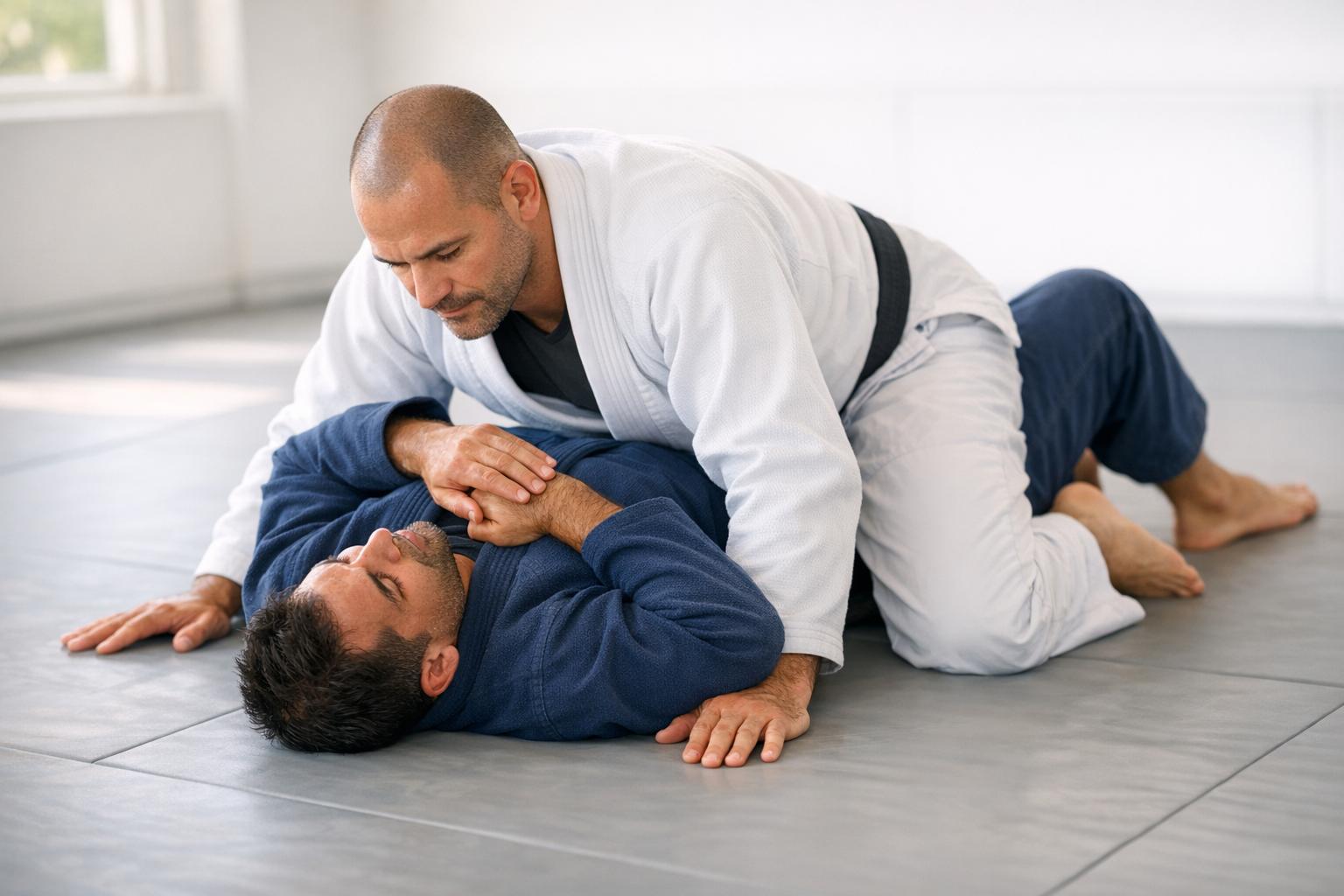
Why Positional Control Matters in BJJ
In Brazilian Jiu-Jitsu (BJJ), positional control is the foundation of success on the mat. It allows you to dominate your opponent, conserve energy, and set up effective submissions. The principle of "Position before submission" highlights the importance of securing a stable position before attempting to finish a match. Here's what you need to know:
- Dominant Positions: Back control, mount, side control, and knee on belly are key positions that give you control and limit your opponent's options.
- Guard: A neutral position that offers opportunities for sweeps, submissions, and defense.
- Physics in BJJ: Leverage, balance, and pressure are essential for controlling opponents, even when they are larger or stronger.
- Training Tips: Positional sparring and movement drills help refine control and develop muscle memory.
- Competition Impact: Positional control is rewarded with points in matches and often determines the outcome.
Mastering positional control is essential for both beginners and advanced practitioners. Focus on drills, understand the positional hierarchy, and prioritize control over submissions. This approach will improve your performance in both training and competition.
BJJ Positions Made Simple for Beginners (Stop Feeling Lost)
sbb-itb-d583f1e
Understanding Position Hierarchy in BJJ
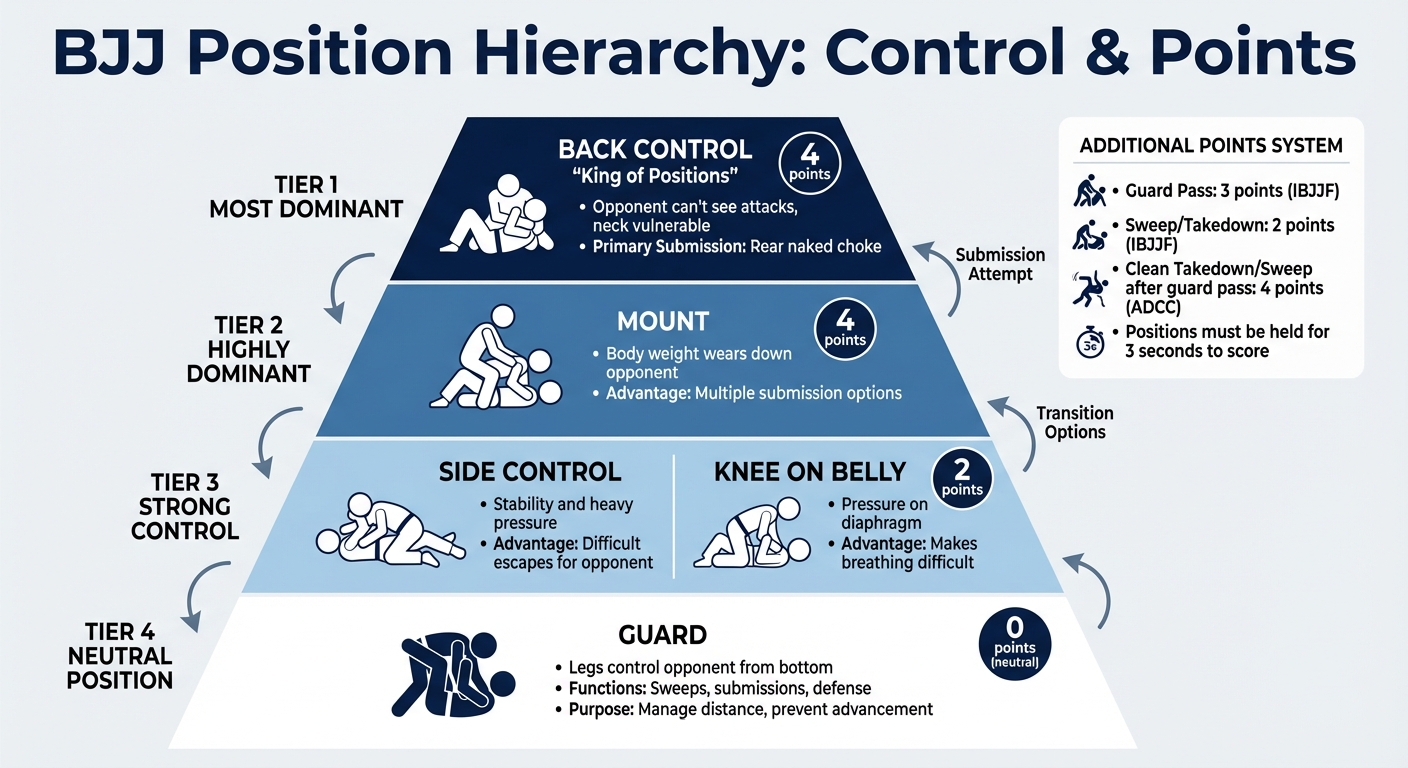
BJJ Positional Hierarchy and Point System
Brazilian Jiu-Jitsu (BJJ) organizes positions based on control, submission potential, and energy efficiency [5]. The goal is to move toward dominant positions while preventing your opponent from doing the same. This ranking system isn't random - it reflects how effectively a position allows you to use leverage and gravity to control your opponent while conserving energy [5]. Dominant positions not only provide better opportunities for submissions but also limit your opponent's ability to counter. In competition, this hierarchy is reinforced by the point system: back control and mount each earn 4 points, while knee on belly is worth 2 points [11].
Top Control Positions
Back control is often referred to as the "King of Positions" for good reason [7]. From this spot, your opponent can't see your attacks, leaving their neck vulnerable. The rear naked choke, the primary submission from back control, is considered one of the most effective submissions in both BJJ and Mixed Martial Arts [7]. With minimal offensive options for your opponent, this position is both highly effective and secure.
Mount follows closely in dominance. By sitting on your opponent’s torso, you apply your body weight to wear them down [7]. The person on the bottom bears your weight while defending against multiple submission threats, which quickly depletes their energy [10]. Mount offers a range of submission options and keeps you in control [11].
Side control and knee on belly are also key dominant positions. Side control provides stability and heavy pressure, making escapes difficult for your opponent [7]. Knee on belly, on the other hand, adds pressure to the diaphragm, making it harder for them to breathe [12]. Both positions allow for smooth transitions to even more dominant spots like mount or back control. While these are strong offensive positions, the guard represents a neutral starting point when you're on the bottom.
Guard Position and Its Functions
Unlike the top positions, which focus on dominance, the guard is a neutral position that offers strategic opportunities. When you're on your back with your legs controlling your opponent, you can manage distance and prevent them from advancing into a dominant position [7]. From the guard, you can sweep your opponent to reverse roles, attack with submissions, or simply hold them at bay until you find an opening. Your legs act as a shield, controlling their posture and stopping them from passing into a stronger position. The guard serves as a foundation for many BJJ strategies, whether you're working to escape to your feet or aiming to transition into a top position. If you're ready to start your journey, you can find a BJJ gym that fits your needs.
How Physics and Body Mechanics Affect Positional Control
In Brazilian Jiu-Jitsu (BJJ), controlling your opponent often comes down to understanding basic physics. By applying principles like leverage, balance, and pressure, even a smaller practitioner can effectively manage and neutralize a larger opponent. These concepts are the backbone of positional control.
Using Leverage and Balance
Leverage is a game-changer when it comes to overcoming size and strength differences. Think of your body as a system of levers, with joints acting as fulcrums. Proper positioning lets you amplify force with minimal effort. As Tatyana Grechina from Easton Training Center puts it:
At its core, leverage involves using a longer force arm to apply maximum pressure with minimal effort.
For example, gripping your opponent's hand at the farthest point from their joint creates maximum mechanical advantage, making it easier to control their movement.
Balance plays an equally important role. Your center of gravity, located just above your hips, needs to stay over your base of support - essentially, the parts of your body touching the mat. If your center of gravity shifts outside this base, you lose stability and open yourself up to sweeps or reversals [13]. Beginners often make the mistake of leaning too far forward, which shifts their weight ahead of their base, making them easy to counter.
By combining leverage with a solid understanding of balance, you can maintain stability and control. Adding pressure to this mix takes your positional dominance to the next level.
Physical Factors in Position Control
Pressure is another key element that turns physics into a tactical advantage. The formula is simple: Pressure = Force / Area [13]. By reducing the contact area between you and your opponent, you can double the pressure without adding any extra weight. For instance, using the edge of your chest instead of its flat surface halves the contact area, instantly increasing the pressure you apply [13]. To push this even further, lift your knees off the mat and drive through your toes, channeling your weight directly into your opponent [13].
Top positions, like knee on belly, make excellent use of these principles. Gravity works in your favor, helping you stay stable while draining your opponent's energy. Knee on belly, for example, targets the diaphragm, making it harder for your opponent to breathe [10][1]. Steve Kwan from BJJ Mental Models highlights how grip control ties everything together:
Whoever wins the grip fight in Jiu-Jitsu often dictates the position.
Dominating grips not only enhances leverage but also sets the foundation for effective positional control. By mastering these interconnected principles, you can turn raw physics into a powerful tool on the mat.
Drills and Exercises for Better Positional Control
Grasping the theory of leverage and pressure is one thing; being able to execute it under pressure is something else entirely. Drills bridge that gap, turning concepts into habits. By isolating specific positions and drilling them repeatedly, you develop the muscle memory and decision-making skills needed to excel during live matches.
Position-Specific Sparring
Positional sparring is a training method where you start in a defined position and reset as soon as a goal is achieved. This approach allows you to sharpen your skills in specific, high-pressure scenarios. As Stephan Kesting, founder of Grapplearts, puts it:
Situational sparring and positional drilling is a training method used by virtually every single black belt and high level BJJ competitor. [16]
Here’s how it works: Select a position - like sitting guard - and set clear objectives for each partner. For example, the top player might aim to pass, while the bottom player works to sweep. Keep rounds short, usually around 1 to 3 minutes, and reset immediately after someone achieves their goal. To refine specific skills, you can add restrictions, such as "no grips allowed" or "control only, no submissions" [20].
The Knee on Belly to Reverse Knee on Belly Drill is a great example of a targeted exercise. From side control, you elevate into a standard knee-on-belly position, then transition to a reverse knee-on-belly (facing your opponent’s hips) as they attempt to frame against you. This drill not only improves hip mobility but also reinforces consistent pressure against defensive movements [19]. Another effective drill is the Side Control Step-Over, where you counter an underhook by stepping over to the opposite side, often transitioning into a figure-four grip [19].
While positional sparring hones control in specific scenarios, movement drills focus on maintaining pressure while staying dynamic.
Movement and Pressure Training
Static positions can give your opponent time to reset and escape. Fluid movement, on the other hand, keeps them off balance and constantly reacting. Drills like the North-South Walk emphasize this dynamic approach. Starting in side control with a crossface, you release the crossface to control the far arm, then "walk" your knees around your opponent’s head into a north-south position, maintaining constant torso contact. This movement prevents your opponent from framing or recovering guard [19].
Solo drills also play a crucial role in developing foundational movement patterns. Exercises like shrimping, bridging, and technical stand-ups build the hip mobility and escape mechanics essential for all positions [17]. For guard retention, the No Hands Guard Drill pushes you to defend using only your legs, improving lower-body coordination and dexterity [2]. Stephan Kesting highlights the importance of these micro-adjustments:
Positional wisdom is the depth of knowledge and your ability to make good judgements in a given position... the ability to make little micro-adjustments with your hips to shut down an escape attempt. [2]
To improve weaker areas, dedicate several weeks to drilling your most challenging positions with training partners [18]. While regular sparring might only give brief exposure to these situations, positional sparring isolates them, allowing for focused practice. Over time, these drills transform technical knowledge into reflexive actions that withstand the pressure of live competition.
Positional Control in BJJ Competitions
In Brazilian Jiu-Jitsu (BJJ) competitions, positional control plays a huge role in determining match outcomes. The scoring system is designed to reward those who demonstrate dominance over their opponents, as this showcases technical mastery. Understanding how positions translate into points - and how they influence energy use - can be the key to success in a competitive setting. This system builds on the foundational drills and strategies discussed earlier.
How Positions Earn Points
In organizations like the IBJJF and ADCC, points for dominant positions are only awarded after maintaining control for at least 3 seconds. For example, the IBJJF awards 4 points for rear mount and mount, 3 points for guard passes, and 2 points for sweeps or takedowns. ADCC, on the other hand, awards 4 points for clean takedowns or sweeps completed after passing the guard [21]. This scoring system encourages competitors to balance pressure with efficiency, conserving energy while maintaining control.
Data from high-level IBJJF competitions show that most matches are decided by points, advantages, or referee decisions, rather than submissions [22]. Even elite athletes like Gordon Ryan rely heavily on positional strategies to set up their finishes. For instance, Ryan achieved a 66% submission rate in IBJJF and 62% in ADCC, with many of his successes rooted in positional control. A detailed review of 35 high-level matches across EBI, IBJJF, and ADCC revealed that his "floating pass" system accounted for over half of his 18 recorded back-takes, while his "saddle position" led to 5 of 6 sweeps during his IBJJF No-Gi World and Pan Championship runs [23]. As John Danaher famously said:
The submission is the final consequence of correct positioning and control.
Conserving Energy Through Position
Efficient positional dominance isn't just about scoring - it also helps conserve energy. When you're in a dominant position, you create an energy imbalance. The person on top can apply controlled pressure, often resting, while the person on the bottom is forced to constantly work to escape or defend. This dynamic drains the opponent's energy and increases the likelihood of technical mistakes [4][9].
Over the course of a match, being ahead on points through positional control forces your opponent to take risks. They may launch high-energy, desperate attacks to close the gap, creating opportunities for counters and submissions while you stay relatively fresh [22]. For example, the mount position gives you the advantage of gravity, allowing you to maintain control with minimal effort while your opponent struggles under your weight [6][8].
Back control is another prime example of efficient dominance. The rear naked choke, often regarded as the most effective submission in both BJJ and MMA, is a direct result of this position. Back control limits your opponent's defensive options and allows you to conserve energy while setting up a decisive finish [7].
Choosing a BJJ Academy for Position Training
Picking the right academy plays a huge role in mastering positional control in Brazilian Jiu-Jitsu. Different schools have varying approaches - some emphasize flashy submissions, while others stick to the "position before submission" philosophy. As Vow BJJ explains:
Position first, control second, and submission last - this formula leads to success in Jiu-Jitsu.
The academy you choose will shape how you approach positional control in every training session. Finding a school that aligns with your goals is crucial, and there are resources available to help with that search.
How Brazilian Jiu-Jitsu Gyms Directory Helps

The Brazilian Jiu-Jitsu Gyms Directory (https://bjjacademyfinder.com) is a useful tool for finding academies that focus on quality instruction, especially for positional control. The platform offers detailed information about U.S.-based schools, including instructor credentials, curriculum breakdowns, and user reviews. You can search by location and compare schools based on their teaching styles and priorities. Whether you're looking for structured positional sparring, a clear progression through the positional hierarchy, or instructors who focus on leverage and precision, this directory can help you find the right fit.
What to Look for in a BJJ Academy
When evaluating academies, check if they incorporate positional sparring into their training, especially from key positions like mount or side control. Timeless Jiu-Jitsu highlights the value of this approach:
With positional sparring, you start directly in the position that you want to work on... each round gives you immediate feedback on your technique.
This method speeds up learning by isolating specific areas for improvement and allowing for repeated practice. Look for schools that teach a clear positional hierarchy - often ranking Back Control and Mount as the most dominant - and focus on control techniques like hip immobilization and weight distribution. Top instructors will also emphasize defensive strategies in tough positions before moving on to advanced escapes, prioritizing leverage and technique over raw strength or speed.
Conclusion
Positional control lies at the heart of Brazilian Jiu-Jitsu. As John Danaher aptly explains:
The submission is the final consequence of correct positioning and control.
Without stable control, attempting submissions turns into a gamble - one that risks reversals or drains your energy unnecessarily. The numbers tell the story: during BJJ sparring, athletes alternate between low- and high-intensity efforts at about an 8:1 ratio, with blood-lactate levels spiking as high as 14.8 ± 3.2 mmol·L⁻¹ in competitive matches [24]. This highlights just how essential energy management is. Positional dominance allows you to conserve energy while your opponent tires themselves out trying to escape.
But it’s more than just energy conservation. Strong positional control sets the tone for the match, applying psychological pressure and dictating the pace. Even without submissions, mastering positions can secure victories. Many point systems heavily reward dominant positions like mount and back control, making positional points a deciding factor in numerous matches [9]. Smooth transitions and consistent pressure often outweigh rushed submission attempts.
Achieving this level of control takes disciplined, focused training. It’s crucial to find an academy that emphasizes the principle of "position before submission." If you're looking for a school that prioritizes positional hierarchy and structured sparring, the Brazilian Jiu-Jitsu Gyms Directory (https://bjjacademyfinder.com) is a valuable resource. This platform provides detailed insights into programs, teaching methods, and user reviews, helping you locate the right academy to match your goals.
Focus on mastering positional control, and submissions will naturally follow. Dedicate time to positional sparring, refine those small but critical adjustments, and trust the process. Your ability to dominate from the ground up will determine your success, whether in training or competition.
FAQs
What’s the fastest way to improve positional control as a beginner?
The fastest way for beginners to get better at positional control in Brazilian Jiu-Jitsu is by focusing on positional sparring. This means repeatedly practicing specific positions - like mount, side control, or back control - over and over. It’s a targeted approach that helps develop both offensive and defensive skills in a structured way.
Another important aspect is learning the positional hierarchy. By mastering dominant positions first, before diving into submissions or transitions, you build a solid base to work from. The key to improving quickly is consistent and intentional practice.
How do I maintain top pressure without burning out my arms?
To keep consistent top pressure without tiring out your arms, let your body weight do the work instead of relying solely on arm strength. Engage your chest and hips to apply pressure, spreading the effort across your body. Positions like side control or mount naturally force your opponent to bear your weight, wearing them down over time. Stay calm and avoid unnecessary tension - this helps conserve energy and prevents your arms from getting fatigued.
Which positions should I focus on first for competition points?
When it comes to grappling, dominant positions like back control and mount are game-changers. These positions aren’t just about control - they’re also highly prized in competitions because they come with high scoring potential. By focusing on securing and maintaining these positions, you can effectively dominate your opponent while racking up points. Prioritizing these key positions is a smart way to elevate your performance and gain a competitive edge.
Related articles
Share this article