
How To Verify BJJ Instructor Lineage
Step-by-step methods to confirm a BJJ instructor's lineage and credentials, spot red flags, and assess teaching quality and student results.

How To Verify BJJ Instructor Lineage
When choosing a Brazilian Jiu-Jitsu (BJJ) academy, verifying your instructor’s lineage is critical to ensure they’re a legitimate black belt with proper training. Lineage is like a martial arts family tree, tracing an instructor’s rank back to the sport’s founders. Here’s how you can check:
- Ask Directly: A genuine instructor can clearly explain who promoted them and their lineage.
- Research Online: Use platforms like Beltchecker.com, BJJ Heroes, or the IBJJF website to confirm credentials.
- Check Directories: Tools like the Brazilian Jiu-Jitsu Gyms Directory provide verified academy and instructor details.
- Evaluate Teaching: Watch their methods and observe student performance during drills or competitions.
- Look for Red Flags: Avoid instructors who can’t name their promoter, show rank inconsistencies, or avoid sparring.
Taking these steps protects you from fraudulent instructors and ensures you’re learning proper techniques. Lineage matters, but teaching quality and student results are just as important.
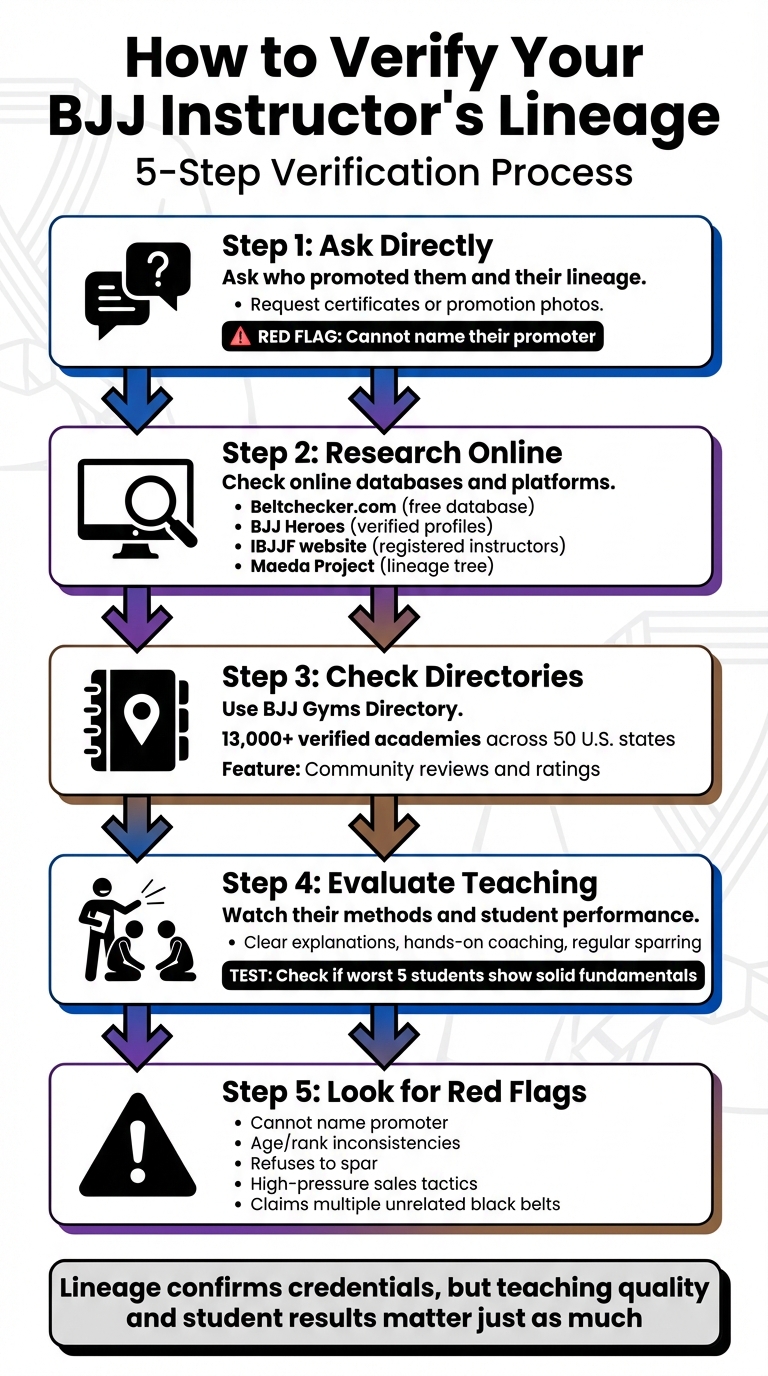
5-Step Process to Verify BJJ Instructor Lineage and Credentials
What BJJ Lineage Is and Why It Matters
Definition of BJJ Lineage
In Brazilian Jiu-Jitsu, lineage acts like a martial arts family tree, tracing the chain of instructors responsible for promoting a practitioner through the ranks. Your official lineage is determined by the person who awarded your black belt.
This lineage often leads back to pioneers like Mitsuyo Maeda, Carlos Gracie, or Helio Gracie. For instance, Gordon Ryan’s lineage goes from Garry Tonon to Tom DeBlass, to Ricardo Almeida, to Renzo Gracie, and ultimately to the origins of BJJ. While most lineages connect to the Gracie family, others exist through students of Mitsuyo Maeda, such as the Luis França lineage.
"Lineage is a traditional concept in martial arts that illustrates loyalty to your teacher. In BJJ, it is a way to ensure that a person's black belt is authentic." - MMA Channel
Understanding this chain helps explain why verifying lineage is so important.
Why You Should Verify Lineage
With such a clear chain of instruction, verifying your instructor’s lineage ensures you’re learning from a credible source. It protects you from wasting time on improper techniques taught by someone who may have self-promoted or purchased their rank online. This verification is crucial for avoiding fraudulent instruction that could lead to injury or poor skill development.
A legitimate lineage guarantees you're learning techniques that have been refined and passed down through generations. Each lineage often carries unique technical or philosophical traits, shaping the style of Jiu-Jitsu taught at a particular academy. At the very least, you should know your coach’s coach - two steps of separation - to confirm the credibility of your school when choosing a gym.
"A genuine black belt is considered a 'Professor' of the art and is deemed to have enough knowledge and skill to recognize and promote students when they are ready." - MMA Channel
Moreover, authentic lineage confirms your instructor has the authority to promote others. In BJJ, earning a black belt signifies "Professor" status, granting the expertise to evaluate and promote students appropriately. Without a verified lineage, any belt promotions you receive may lack legitimacy within the broader BJJ community.
sbb-itb-d583f1e
How to Verify an Instructor's Lineage
Ask the Instructor Directly
One of the simplest ways to verify an instructor's lineage is to ask them directly. A legitimate black belt should be able to explain who awarded them their rank and trace their lineage back to the founders of the art. You can request details such as the name of their promoting professor, the dates of their promotions, and even supporting documentation like certificates or photos from promotion ceremonies.
"If your instructor is unable to give a clear answer as to who awarded them their black belt, or if they will not disclose that information, they may not be an authentic BJJ black belt." - mmachannel.com [3]
Research Online
Online research is another effective method for verifying an instructor's credentials. Websites like Beltchecker.com provide a free, community-driven database where you can search for instructor profiles. Verified profiles and lineage trees on platforms like BJJ Heroes and the Maeda Project add another layer of credibility. The Maeda Project, while currently read-only, offers an interactive lineage tree tracing connections back to key historical figures like Mitsuyo Maeda and Carlos Gracie [5].
Additionally, the International Brazilian Jiu-Jitsu Federation (IBJJF) website lists registered instructors certified for sanctioned events [6]. Social media and BJJ forums can also be helpful for finding promotion photos or discussions that confirm an instructor's claims. These platforms often showcase the higher-ranking black belts who awarded the rank, providing further evidence.
"Community verification can certify that your skills and credentials are legitimate. This can be helpful if you are competing, teaching, or need to prove your rank in other ways." - Beltchecker [6]
To be thorough, you can also consult trusted academy directories for additional confirmation.
Check the Brazilian Jiu-Jitsu Gyms Directory

The Brazilian Jiu-Jitsu Gyms Directory (https://bjjacademyfinder.com) is a valuable tool for verifying an instructor's background. With over 13,000 verified academies across all 50 U.S. states [7], this directory includes detailed profiles for each academy, listing instructor credentials and lineage information. By searching for a specific academy, you can review its profile to assess the legitimacy of the training offered.
User reviews and ratings in the directory provide additional insights. Community-verified listings are highlighted, making it easier to identify top-rated academies. Many of these academies boast 5.0-star ratings based on multiple reviews, offering further reassurance [7].
For a more thorough check, cross-reference an instructor's information from the directory with their Beltchecker profile to review their full belt promotion history and community verification status [6]. This layered approach ensures you have a complete picture of their legitimacy.
Assessing Instructor Quality Beyond Lineage
While lineage can confirm an instructor's background, it’s just one piece of the puzzle. To truly evaluate an instructor, you need to look at their teaching methods and how their students perform.
Watch Their Teaching Methods
Having a legitimate black belt and an impressive lineage doesn’t automatically make someone a skilled teacher. What really matters is how they communicate and break down techniques. A great instructor explains complex moves in clear, manageable steps and dives into the why behind the details, not just the how. Quick, rushed demonstrations without explanation often lead to students developing bad habits [8].
Take note of how students respond during drills. Are they performing techniques correctly, or do they look lost? A dedicated instructor actively moves around the mat, offering feedback and corrections instead of staying on the sidelines. This hands-on coaching approach sets apart committed teachers from those who simply demonstrate and leave students to figure things out.
Regular sparring sessions are another sign of a quality instructor. Sparring not only showcases their current skills but also reinforces their ability to teach effectively in real-time scenarios.
"A prestigious lineage means nothing if the coach can't communicate. Some world-class competitors are terrible teachers" [1].
That said, if an instructor has age-related or injury-related limitations, they should still stay actively involved in teaching and guiding students.
Ultimately, while good teaching is visible on the mat, the results seen in students provide even stronger proof of an instructor's effectiveness.
Look at Student Results
Observing student performance is just as important as evaluating teaching methods.
One way to measure an instructor’s ability is through what’s called the "worst student" test. As Matthew Tropp from BJJ Report puts it:
"The 5 worst students are the true test of an academy's tutelage. Are the 5 worst students killers in their own right, or at least competent practitioners? If so, it means that the instructors are able to adapt their teaching style" [9].
Even students with the least experience should demonstrate solid fundamentals if the instruction is strong.
Another key indicator is competition success across all belt levels. Look for academies where white, blue, purple, and brown belts consistently perform well at local and regional tournaments - not just one or two standout athletes. For example, in the 2016 Jiu-Jitsu World Championship, students of Julio Cesar Pereira earned an impressive 35 podium spots. This highlights how excellent coaching can elevate the entire group, not just a few naturally talented individuals [3]. When visiting a gym, check for trophies and medals that reflect team success rather than just the instructor’s personal achievements.
Red Flags to Watch For
When evaluating an instructor's lineage in Brazilian Jiu-Jitsu (BJJ), it's crucial to stay alert to potential warning signs. Even well-meaning instructors may sometimes have questionable credentials, and recognizing these red flags can save you from wasting time, money, and effort.
Warning Signs of Questionable Credentials
One of the most glaring red flags is when an instructor cannot name the person who promoted them. As BJJ Fanatics explains:
"If an instructor cannot tell you who he or she got their belt from, that is a big red flag." [4]
Legitimate instructors are usually proud of their lineage and can clearly trace it through their teachers. If an instructor gives vague answers or avoids discussing their training history, it’s worth questioning their credibility.
Age and rank inconsistencies are another red flag. For example, IBJJF standards require a minimum age of 50 for a 7th-degree coral belt, 57 for an 8th-degree, and 67 for a 9th-degree red belt. Claims of achieving these ranks at significantly younger ages are highly unlikely and should raise doubts [3]. Similarly, be wary of instructors who claim multiple high-degree black belts in unrelated or obscure martial arts alongside their BJJ rank - this often signals exaggerated or fabricated credentials.
Technical shortcomings are another clear indicator. If an instructor struggles with basic techniques or outright refuses to spar, it’s a serious concern. While older instructors or those with injuries may spar less frequently, younger instructors who avoid rolling might be hiding a lack of skill. Additionally, academies that discourage competition may do so to conceal an instructor’s technical weaknesses, as tournament success often reflects genuine ability and effective teaching [1].
Beyond credentials, how instructors market themselves can also reveal a lot.
How to Spot Misleading Marketing
Misleading marketing is another area where red flags often appear. Be cautious of extravagant claims, such as being an ex-Navy SEAL or receiving promotions through divine intervention, without any verifiable proof. One infamous example involves Tyrion Scott, a blue belt who claimed "God promoted him" to black belt and even created his own "Seminary Jiu-Jitsu" system. His lack of legitimate skills became evident when he was easily outperformed on the mat [11].
Another concern is the promotion of "technical" belts - credentials earned through video submissions or online courses. These belts do not hold the same value as those earned through traditional, hands-on training and should be viewed with skepticism.
Lastly, watch out for "McDojo" practices. High-pressure sales tactics, mandatory long-term contracts, and requirements for exclusive academy gear often signal a business-first mentality rather than a focus on quality instruction [10]. If promotional materials emphasize unrelated martial arts titles over a verifiable BJJ lineage, take the time to investigate further before committing to any program.
Conclusion
Checking your BJJ instructor's lineage is a smart way to safeguard your investment of time, money, and effort, while also ensuring your safety. As MMA Channel explains:
"Verifying a BJJ black belt's lineage will ensure you receive quality training from a certified BJJ black belt instructor. Training under a fraudulent instructor will teach you poor and incomplete techniques." [3]
The process of verification is straightforward. You can confirm credentials by asking directly or using trusted online databases. Additionally, pay attention to their teaching approach and the performance of their students in competitions.
A resource like the Brazilian Jiu-Jitsu Gyms Directory (bjjacademyfinder.com) can make this task even easier. With a database of over 13,000 verified academies across all 50 states, it offers detailed instructor credentials, community reviews, and ratings to help you identify legitimate schools [7].
While verifying lineage confirms qualifications, it doesn't guarantee teaching skill. Take the time to evaluate their methods, results, and the gym's overall culture. As Archimedes Jiu-Jitsu Academy points out:
"If your coach is not being honest with you about who they promoted or trained under they may be dishonest about other aspects of their training and their business." [2]
FAQs
What proof should a real BJJ black belt show?
A legitimate BJJ black belt should be able to present proof of their rank. This could be something like a photo or a video showing their instructor tying the black belt on them. Additionally, they should be able to trace their lineage back to the founders of Brazilian Jiu-Jitsu, such as Helio Gracie or Carlos Gracie. This connection highlights a credible and verifiable training history.
How can I verify lineage if the instructor isn’t IBJJF-registered?
To check an instructor's lineage, find out who awarded their black belt and see if it connects back to early Brazilian Jiu-Jitsu figures like Helio or Carlos Gracie, or even Mitsuyo Maeda. Platforms like Beltchecker can be a helpful resource for verifying credentials. This approach ensures their training history is both credible and easy to trace.
What matters more: lineage or teaching ability?
Understanding an instructor's lineage can give you insight into their credibility and training background. It offers a historical perspective on the techniques they teach and the traditions they follow. However, when it comes to your learning experience, an instructor's ability to teach effectively matters much more. The best instructors not only know their craft but can also break down techniques clearly and adjust their approach to meet the unique needs of their students.
Related articles
Share this article