
How to Measure for a BJJ Gi
Measure weight, chest, waist, arms and legs, check brand size charts and cuts, and account for shrinkage to find a properly fitting BJJ gi.
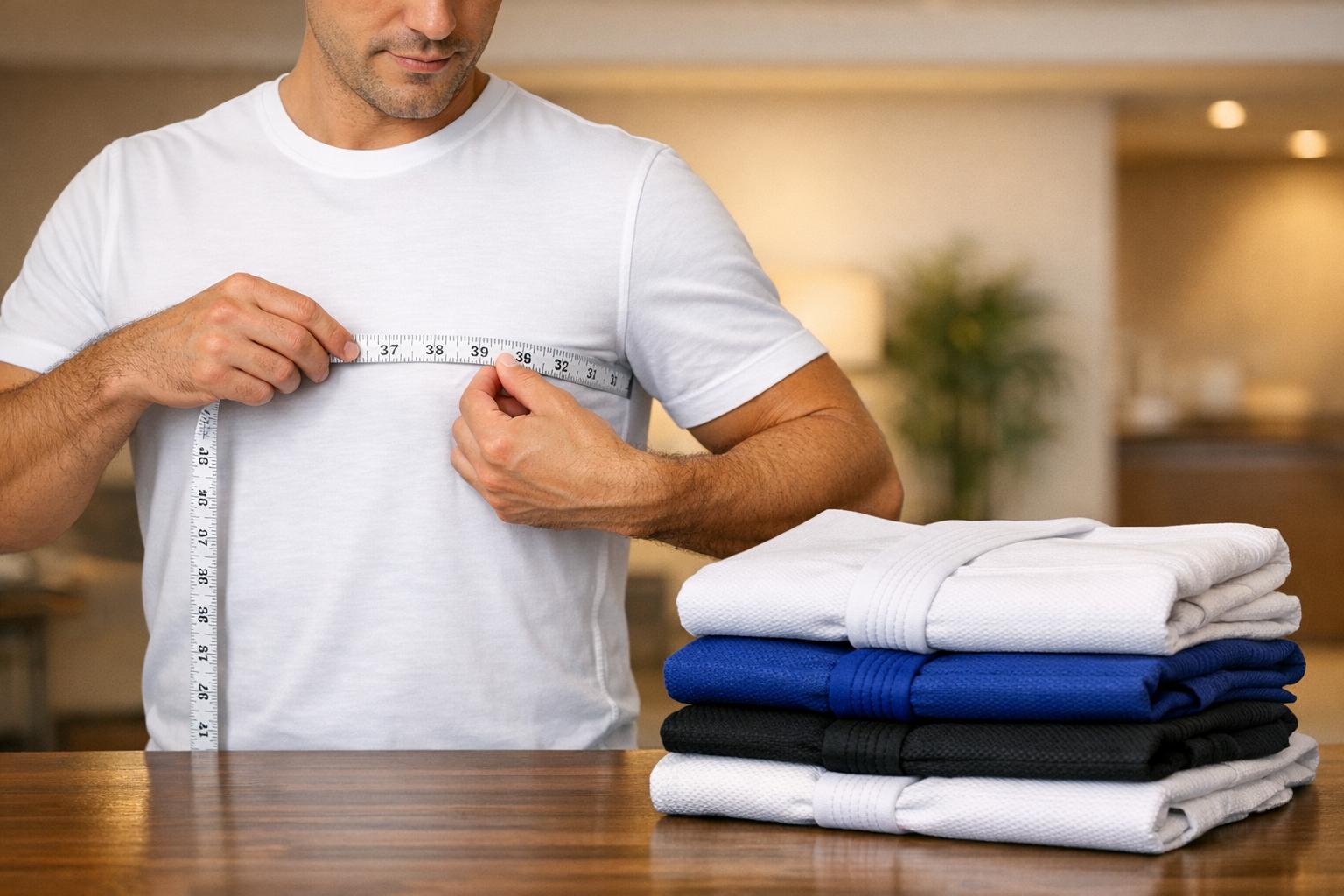
How to Measure for a BJJ Gi
Finding the right BJJ gi size is straightforward when you know what to measure. Here's a quick guide:
- Focus on Weight: Weight is the most critical factor for gi sizing. Height helps with sleeve and pant length but is secondary.
- Measure Key Areas: Use a flexible tape measure to record your chest, waist, arm, and leg lengths. Stand barefoot against a wall to measure your height.
- Understand Sizing Systems: Adult gis use the A-series (A0–A6), women’s gis use the F-series (F0–F4), and kids’ gis follow Y, M, C, or K systems. Some brands offer in-between sizes like "L" (Long), "S" (Short), and "H" (Heavy) for different body types.
- Check Brand Charts: Sizes vary by brand, so always compare your measurements to their specific size chart.
- Account for Shrinkage: Most gis shrink 1–10% after washing. Wash in cold water and hang to dry for minimal shrinkage.
A well-fitted gi improves mobility and meets competition rules, ensuring sleeves and pants are within 2 inches of the wrist and ankle. Always prioritize comfort and functionality for training or competition. Once you have your gear, you can find a BJJ gym nearby to start your journey.
How a BJJ Gi Should Fit - Travis Stevens
sbb-itb-d583f1e
BJJ Gi Sizing System Basics
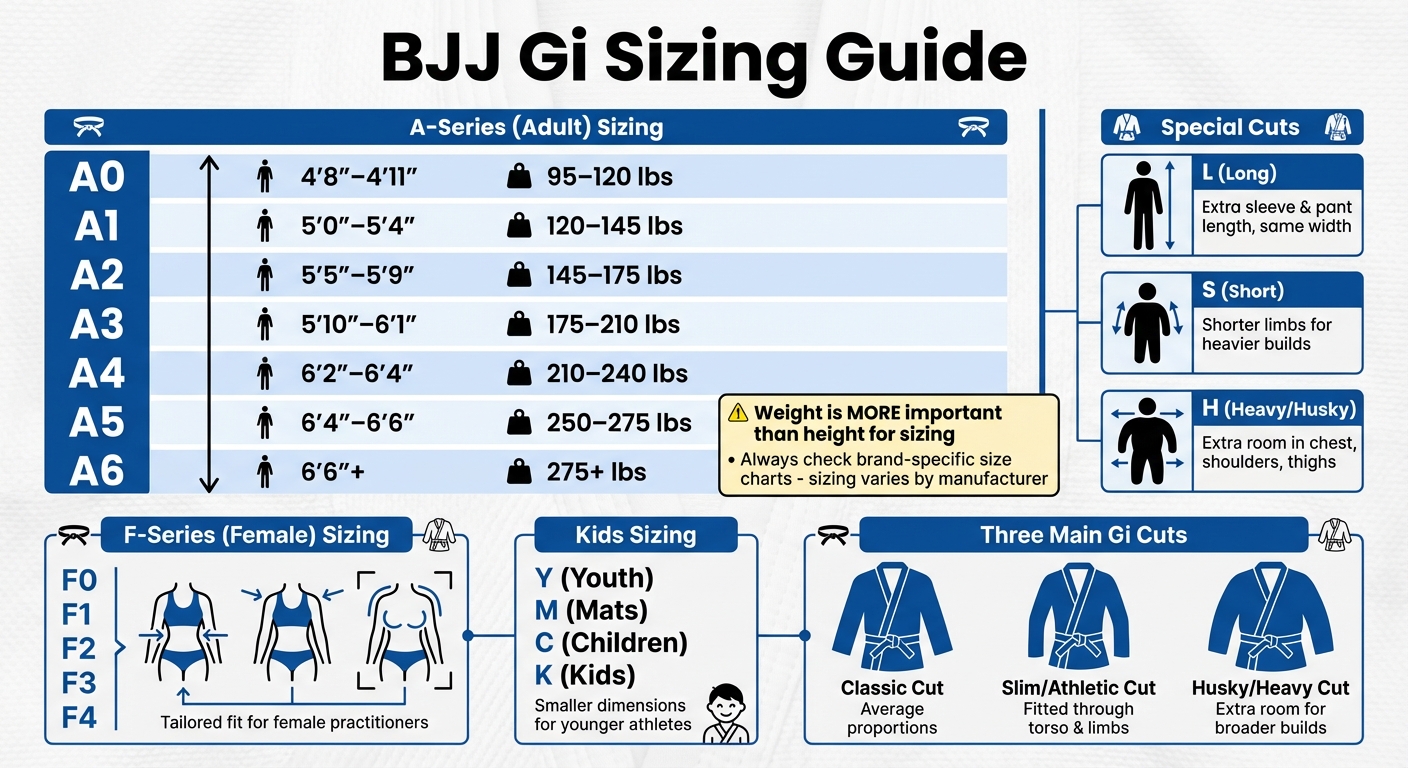
BJJ Gi Sizing Chart: A-Series, F-Series, and Special Cuts Guide
Getting the right size for your BJJ gi is essential for maintaining both control and mobility during training. The sizing system for BJJ gis typically follows the A-series (A0–A6), which corresponds to specific height and weight ranges. For instance, an A0 is designed for individuals between 4'8"–4'11" and 95–120 lbs, while an A5 accommodates those who are 6'4"–6'6" and weigh between 250–275 lbs. But it doesn't stop there - factors like weight, gender, and brand design also play a key role in finding the perfect fit.
When it comes to sizing, weight often outweighs height in importance. Zack Nicholas, a Brown Belt practitioner, offers this advice:
Use your weight as the ultimate measurement when looking at different gi size charts (minor discrepancies in sleeve or pant length matter less than the overall body fit).
Your weight ensures the jacket fits securely and the pants accommodate your waist and thighs, while height mainly influences sleeve and pant leg length.
For women, gis are sized using the F-series (F0 to F4). These are tailored with features like tapered waists, narrower shoulders, and contoured chests to better fit female practitioners. Kids' gis, on the other hand, use prefixes like Y (Youth), M (Mats), C (Children), or K (Kids), offering smaller dimensions suited for younger athletes.
To accommodate different body types, many brands also offer in-between sizes. For example, Long (L) sizes, like an A2L, provide extra length in the sleeves and pants while maintaining the width of an A2. Short (S) sizes cater to stockier builds, and Heavy or Husky (H) cuts add more room in the chest, shoulders, and thighs for broader individuals.
Brand-to-Brand Sizing Differences
An A2 in one brand might not fit the same as an A2 in another. Different manufacturers design their gis with unique dimensions. Some brands may offer a wider torso, while others focus on a more tapered fit through the sleeves and pants.
To avoid surprises, always check the size chart for the specific brand you're considering. Keep in mind that dimensions for a particular size can vary by several inches or pounds depending on the manufacturer. If you're between sizes, it's usually better to go with the larger option. A larger gi can be shrunk or tailored, but a gi that's too small offers no such flexibility. Beyond the size chart, the cut of the gi also plays a big role in achieving the right fit.
Gi Cut Types: Classic, Slim, and Husky
BJJ gis come in three main cuts to suit different body shapes.
- Classic cuts offer a standard, boxy fit that works well for those with average proportions.
- Slim or athletic cuts are tapered through the torso and limbs, providing a closer, more fitted look.
- Husky or heavy cuts give extra room in the chest, shoulders, and thighs, making them ideal for broader practitioners.
Each cut has its own advantages, so think about your comfort and performance needs when selecting your gi. A well-fitted gi not only improves your mobility but also enhances your overall training experience.
What You Need to Measure Correctly
Getting accurate measurements is all about using the right tools and setting things up properly. A mistake here can mean ending up with a poorly fitting gi, so it's worth taking the time to do it right. Before you begin, make sure you’ve got the proper tools and are working in a suitable environment. The wrong gear or conditions can throw off your results, leaving you with a gi that doesn’t fit well.
Tools You’ll Need
The basics? A flexible tailor’s measuring tape and a scale. These are non-negotiable if you want precise measurements. The tape helps measure your body’s dimensions, while the scale gives you your weight, which is often a key factor in gi sizing.
Having someone to assist you is also a game-changer. Jesse Bellavance, Owner of Killer Bee Gi, emphasizes this point:
"Once you have your tape in hand it is best to give it to someone else to do the actual measuring or your results will likely lead to poor measurements and fit."
For height, you’ll need a flat surface like a wall or baseboard, and if you’re comparing sizes with an existing gi, a ruler or yardstick can be handy.
Here’s a quick breakdown of the tools and their purposes:
| Tool | Purpose |
|---|---|
| Flexible Tape Measure | Measuring body dimensions like chest, waist, and limbs |
| Scale | Determining weight, a key factor in gi sizing |
| Helper | Ensuring the tape is level and measurements are accurate |
| Wall/Baseboard | Providing a straight surface for height measurement |
Once you’ve gathered your tools, it’s time to get yourself and your environment ready for precise measuring.
Preparing for Accurate Measurements
With your tools in hand, follow a few simple steps to make sure your measurements are spot-on.
First, wear minimal clothing - think underwear or compression shorts. Extra layers can add bulk and lead to measurements that are too large. When measuring your height, stand straight with your back against a wall and your heels touching the baseboard. Go barefoot for the most accurate results.
When using the tape, keep it snug but not so tight that it digs into your skin. It should stay level and horizontal to the ground. For each measurement, take it twice and go with the larger number to avoid a fit that’s too tight. It’s also a good idea to record your measurements in both inches and centimeters since different brands may use varying standards.
How to Take Your Body Measurements
When measuring your body, be sure to record the results in both inches and centimeters for accuracy and convenience.
Chest and Waist Measurements
Begin with your chest. Wrap a measuring tape around the fullest part of your chest, ensuring it goes under your armpits and across your shoulder blades. Keep your chest slightly expanded to allow for a comfortable fit.
For your waist, measure at your natural waistline, typically around your navel, or at the position where you prefer your gi pants to sit. If your hips are broader, it’s a good idea to measure around the widest part of your hips, as this might be more relevant for pant sizing than your waist measurement.
Arm and Leg Length Measurements
For your arms, measure from the shoulder seam down to your wrist with your arm fully extended. Alternatively, you can measure the distance between your two closed fists (held straight out) and add 2 inches to account for movement and potential shrinkage.
When measuring your legs, focus on the total pant length, which is the distance from your waistline to the bottom of your outer ankle bone. This is not the same as the inseam. If you're competing, keep in mind that the IBJJF requires gi pants to be no more than 2 inches (5 cm) above the ankle bone, so precision here is key.
Height and Weight
For height, stand barefoot against a wall and measure from the floor to the top of your head. When weighing yourself, do so while wearing your training attire for the most relevant measurement.
Weight is especially important when choosing a gi. As brown belt practitioner Zack Nicholas explains:
"Use your weight as the ultimate measurement when looking at different gi size charts (it's okay if the sleeves or pants run a little long or short but the fit on your body will make it wearable or not)."
While height can guide you, prioritize weight when selecting a gi. A snug fit around the chest or waist is critical since these areas can't easily be adjusted, whereas sleeve or pant lengths can often be tailored. Weight directly impacts the overall fit and mobility of the gi, as well as how well the jacket closes.
Using Size Charts to Find Your Gi Size
Reading Brand Size Charts
Once you've got your measurements, the next step is matching them to the size chart provided by the brand. Most brands base their sizing primarily on weight to ensure the gi fits snugly around your torso and thighs, with height acting as a secondary factor.
You'll notice that brand size charts use letter codes to categorize their gis: "A" for Adults, "F" for Females, and "M" or "C" for Children. For adults, sizes are further broken down into numbers like A1, A2, A3, and so on, with each size tailored to fit specific height and weight ranges.
If you find yourself between sizes, it's usually best to go with the larger option. A slightly oversized gi can be adjusted by washing and drying, but a gi that’s too small won’t give you the same flexibility. As RollBliss points out:
"If you're in between sizes, weight is often the deciding factor".
For individuals with a leaner build, the smaller size may work just fine. However, if you have a broader or more muscular frame, sizing up will likely be the better choice.
Choosing the Right Cut for Your Body Type
While the size chart helps you find a general fit, the cut of the gi plays a key role in ensuring maximum comfort and functionality. Since measurements alone don't account for body shape, selecting the right cut can make all the difference.
Some gis include designations like "L" or "T" for Long or Tall cuts, which are made for those who are taller than one size allows but too light for the next size up. These cuts maintain the standard body width but add extra length to the sleeves and pant legs.
On the other hand, "S" stands for Short, catering to heavier individuals who find standard sizes too lengthy in the arms and legs. Similarly, "H" (Heavy or Husky) provides extra width in the jacket and pants for broader builds. Some brands even offer "XL" for additional width.
Here’s a quick guide to these abbreviations:
| Abbreviation | Ideal For |
|---|---|
| L (Long) | Taller, lean practitioners who are too light for the next size up |
| S (Short) | Heavier individuals who need shorter limb lengths |
| H (Heavy) | Broader practitioners needing more room in the jacket and pants |
| F (Female) | Tapered waists and adjusted chest areas for women |
When choosing your gi, prioritize how it fits your body over how it fits your limbs. As Valor Fightwear explains:
"In most cases, you are better off going with a size that will fit you better in the body even if it means the sleeves and trousers are slightly too short for you".
If needed, sleeves and pants can be tailored, but a jacket that doesn’t close properly or pants that feel too tight will interfere with your training and overall comfort.
Checking Fit and Planning for Shrinkage
Testing Your Gi Fit
When your gi arrives, try it on right away - before washing it. This final check helps confirm that the size you chose matches your earlier measurements and the size chart recommendations. Stretch your arms straight out in front of you; the sleeves should reach your wrist joint. For competitions, keep in mind that sleeves must not be shorter than 2 inches (5 cm) from the wrist. The same guideline applies to your pants: the hems should rest just above your ankle bone and must also stay within 2 inches of it.
Another way to check is by using the four-finger test. Place four fingers horizontally between the gi cuff and your wrist or ankle to ensure it meets the required standards. Additionally, make sure the jacket lapels overlap comfortably without pulling, and that the skirt covers your hips adequately.
To test functionality, perform a few movements - squats, lunges, and arm circles - to ensure the fabric doesn’t restrict your range of motion or cause discomfort like chafing. Michael Tremblay, a Black Belt Jiu Jitsu Instructor at Hayabusa, advises:
"A tighter gi seems like an advantage since it makes grabbing your gi harder, it comes at the cost of your fluidity as you roll".
Once you’ve confirmed that the gi fits properly and complies with competition rules, it’s time to think about how washing might affect its size.
Understanding Fabric Shrinkage
Most BJJ gis will shrink by about 1 to 2 inches after being washed in warm water. Non-preshrunk gis tend to shrink more - typically between 5% and 10% during the first few washes - whereas preshrunk gis usually shrink only 1% to 3%. The material plays a big role here: cotton and hemp-based gis shrink more than polyester or synthetic blends.
If your gi fits perfectly right out of the bag, wash it in cold water (90–110°F) and hang it to dry to minimize shrinkage. On the other hand, if your gi feels a bit too large, washing it in warm water (110–120°F) can help shrink it down to size. If you decide to use a dryer, check the fit every five minutes to avoid over-shrinking or damaging the collar. Once you’ve achieved the ideal fit, stick to washing in cold water and hang drying to maintain its size.
Conclusion
Start by taking precise body measurements - chest, waist, height, and limb lengths - and compare them against the brand's size chart. Keep in mind that sizing can vary widely between manufacturers, and weight often plays a key role if you're between sizes.
A properly fitted gi not only enhances your performance but also complies with IBJJF standards, which require sleeves to end within 2 inches of the wrist and pants within 2 inches of the ankle. A snug fit supports fluid movements, like executing arm bars or guard passes, while reducing excess fabric that opponents can grab. As Bravo explains:
A well-fitted gi allows for unrestricted movement, enabling practitioners to flow from one position to another with ease.
Remember to account for shrinkage: wash your gi in cold water and hang it to dry to maintain its fit. If you're unsure about sizing, go for the larger option - you can always shrink a gi, but you can’t make it bigger.
If you're still navigating the process of finding the right gi, additional resources can help. Check out a local academy using the Brazilian Jiu-Jitsu Gyms Directory. Many academies have rental programs, letting you try different sizes and cuts before committing to a purchase. Plus, experienced instructors can offer insights on brands and styles that suit your needs for both training and competition.
Getting your measurements right is the first step toward ensuring comfort and peak performance in Brazilian Jiu-Jitsu, whether you're training hard or stepping onto the competition mat.
FAQs
How do I choose the right BJJ gi cut for my body and training needs?
Choosing the right BJJ gi cut comes down to your body type and how you plan to use it. Most brands offer a standard cut - often called the A-series - that works for a variety of shapes. But if you need something more tailored, specialty cuts are available. For instance, A1L is great for taller, slimmer athletes, while A2H is better suited for those with a shorter, stockier build. If you’ve got longer limbs, a tall-slim cut ensures the sleeves and pants are the right length without extra bagginess. On the flip side, a short-heavy cut gives more space in the torso and thighs, offering added comfort for compact builds.
Some gis are also designed with specific uses in mind, like competition or training. Competition gis tend to have a slimmer fit, with tighter sleeves and pants to make it harder for opponents to grab. Training gis, however, are usually a bit looser, prioritizing comfort and durability for everyday use. To find the right size, start by measuring your height and weight, then check the brand’s size chart. If you’re between sizes, it’s safer to choose the larger one - you can always shrink it in hot water or have it tailored to fine-tune the fit.
Don’t forget to review your gym’s or tournament’s rules for gi requirements, like sleeve length or fabric thickness, to make sure your choice is compliant. A properly fitted gi not only keeps you comfortable during training but also boosts your confidence when competing.
What can I do if my BJJ gi shrinks too much after washing?
If your gi ends up shrinking more than you'd like, try soaking it in cool water to help loosen the fibers. Once it's damp, gently stretch it back to its original size. Lay it flat to air-dry - steer clear of the dryer, as heat will only make the shrinkage worse. To prevent this from happening again, stick to washing in cold water and hang-drying.
Which is more important for selecting the right BJJ gi size: weight or height?
When picking the right BJJ gi size, your weight plays the biggest role in determining how well it will fit. Height comes into play as a secondary factor, helping to fine-tune the fit for better comfort and mobility.
Always check the manufacturer's size chart since sizing can differ slightly between brands. If you find yourself between sizes, think about your preference - do you like a looser fit, or do you prefer something more snug? Also, keep in mind that some gis may shrink after washing, which could impact the fit over time.
Related articles
Share this article