
Why BJJ is Great for Kids' Fitness
How Brazilian Jiu-Jitsu improves kids' fitness: builds strength, flexibility, cardio and endurance while teaching discipline, confidence and healthy habits.
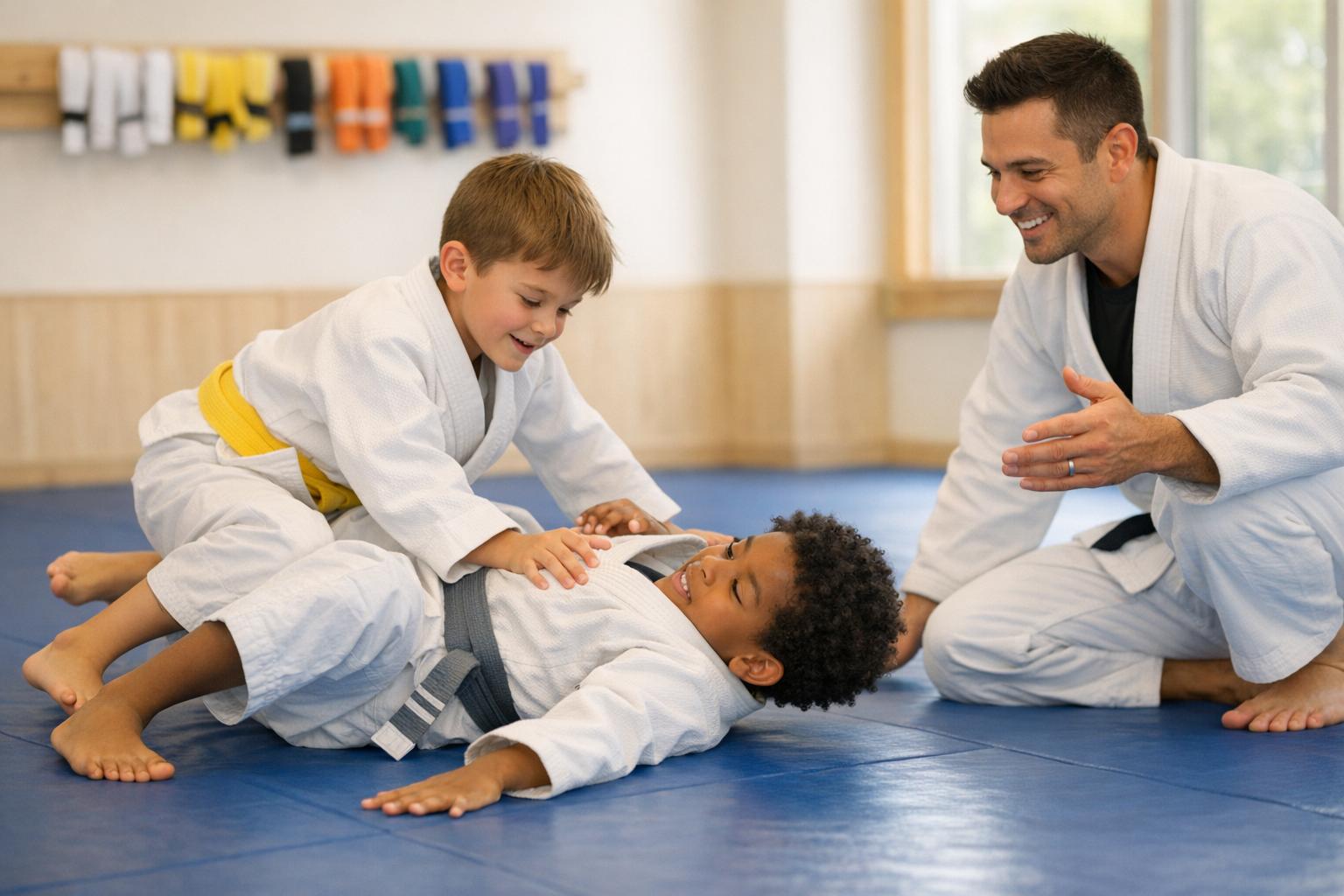
Why BJJ is Great for Kids' Fitness
Brazilian Jiu-Jitsu (BJJ) is a highly effective way to keep kids active while addressing the growing fitness challenges among children in the U.S. With 18.5% of kids classified as obese and only a fraction meeting the recommended 60 minutes of daily activity, finding the perfect BJJ gym nearby offers a fun, engaging alternative to traditional sports. Here's why BJJ stands out:
- Improves Physical Fitness: Builds strength, flexibility, and cardiovascular health through dynamic movements like grappling, shrimping, and sparring.
- Supports Mental Growth: Encourages focus, discipline, and resilience, teaching kids to overcome challenges and build confidence.
- Encourages Healthy Habits: Promotes better lifestyle choices, including proper sleep and nutrition.
- Keeps Kids Engaged: Unlike many sports with high dropout rates, BJJ offers individual progression, maintaining interest and motivation.
BJJ combines physical activity with problem-solving, making it an excellent choice for improving both fitness and mental well-being in children. It's more than exercise - it's a full-body and mind workout that keeps kids moving, learning, and growing.
Top 5 Reasons Kids Get Started in Jiu Jitsu
sbb-itb-d583f1e
How Brazilian Jiu-Jitsu Improves Physical Fitness
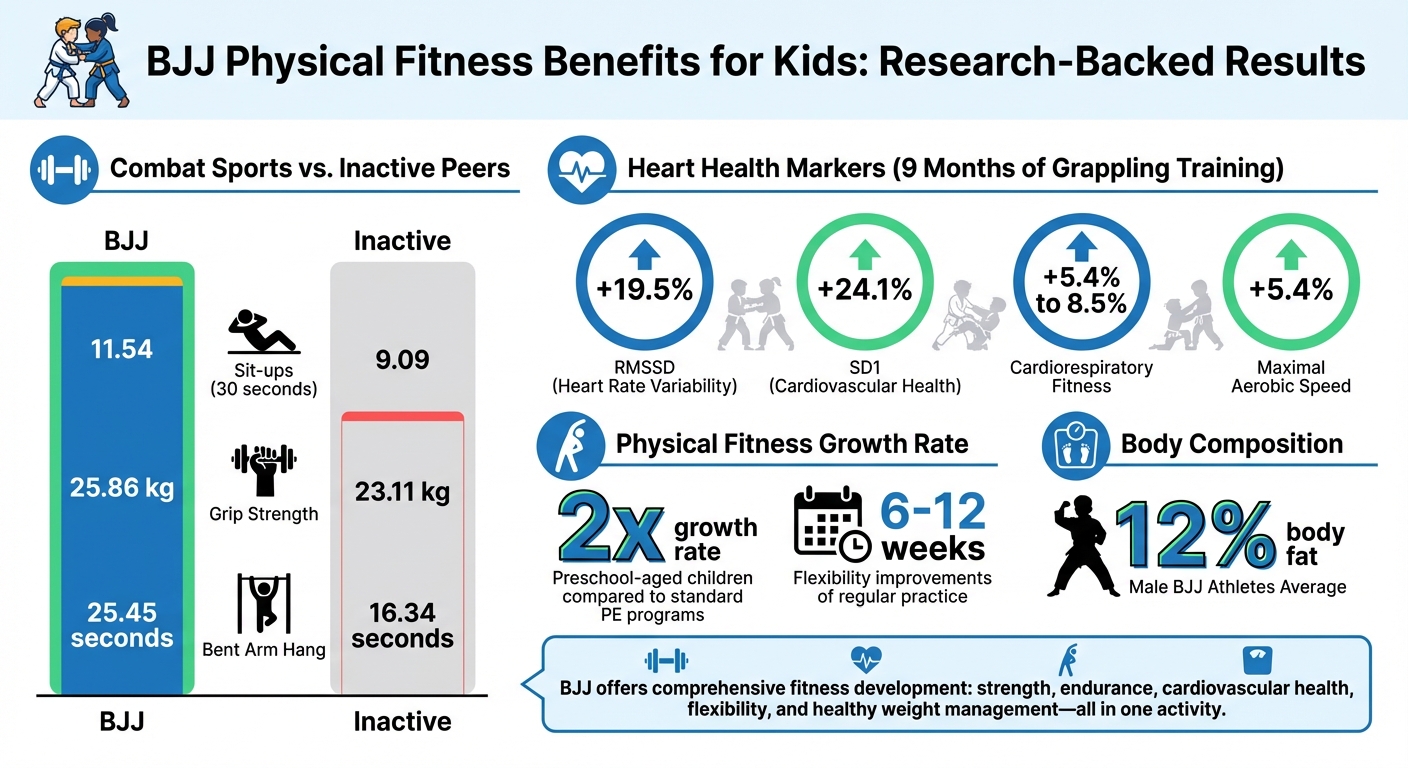
BJJ Fitness Benefits for Kids: Key Statistics and Health Improvements
Brazilian Jiu-Jitsu (BJJ) offers an all-encompassing workout that targets various aspects of physical fitness in a single session. Unlike repetitive gym routines or conventional sports drills, the grappling-based techniques in BJJ help kids develop strength, flexibility, and cardiovascular health simultaneously.
Building Strength and Endurance
BJJ builds real-world strength by requiring sustained, coordinated muscle effort in every takedown, sweep, and hold [10][12]. The sport also enhances muscular endurance through continuous gripping and technical execution, especially when using the gi [10].
Research highlights how effective BJJ is for young practitioners. In a 2025 study, eight-year-olds involved in combat sports like BJJ outperformed their inactive peers in multiple fitness tests. For example, these young athletes averaged 11.54 sit-ups in 30 seconds, compared to 9.09 for non-participants. Their grip strength reached 25.86 kg, outpacing the 23.11 kg of their inactive counterparts, and they held bent arm hangs for 25.45 seconds, significantly longer than the 16.34 seconds achieved by non-participants [9].
For older practitioners, the benefits are equally impressive. A 12-week BJJ program for young adults resulted in better muscle mass, improved upper and lower body strength, and greater muscular endurance [12]. The International Brazilian Jiu-Jitsu Federation emphasizes these advantages:
"The combination of movements performed in jiu-jitsu, the use of the body along with the mental stimulation, make for a mind-stimulating workout great for anyone, although particularly advantageous for children." [11]
BJJ training also incorporates functional bodyweight exercises like bridging, shrimping, and "sprouting", which lay the groundwork for muscular development [12]. These exercises teach kids to rely on leverage and technique rather than brute force, helping children of all sizes develop strength at their own pace [11]. This foundation not only builds strength but also enhances coordination and flexibility.
Improving Flexibility and Coordination
BJJ goes beyond strength training by improving overall mobility. The wide range of motion required for its techniques naturally boosts joint flexibility and muscle elasticity over time [12]. Movements like shrimping, bridging, and technical stand-ups help kids improve motor coordination and proprioception - their ability to sense and control their body’s position in space [6][12].
Unlike traditional sports that often focus on linear, upright movements, BJJ emphasizes multi-directional agility and horizontal motion, offering a broader range of motor skill development [13]. A systematic review of martial arts programs found that grappling-based activities like Judo significantly improved agility, as measured by shuttle run tests, after just nine months [2]. Even preschool-aged children experienced double the growth rate in physical fitness compared to those in standard physical education programs, with the highest gains in balance-related tasks [2].
Regular BJJ practice can also enhance flexibility in as little as 6 to 12 weeks [12]. Mid-America Martial Arts highlights these benefits:
"Brazilian Jiu-Jitsu offers a comprehensive range of benefits for children... From physical fitness and self-discipline to social skills and self-defense, BJJ provides a holistic approach to youth development." [6]
In addition to improving mobility, the sport’s varied intensity levels contribute to heart health and effective weight management.
Supporting Heart Health and Weight Management
BJJ provides a cardiovascular workout that alternates between high and low intensities, similar to high-intensity interval training (HIIT) [10]. This dynamic approach improves cardiorespiratory endurance, enabling kids to sustain effort longer and recover faster [15][10].
Studies underscore the cardiovascular benefits of grappling-based martial arts. For instance, nine months of grappling training (like Judo) led to a 19.5% increase in RMSSD - a marker of heart rate variability - and a 24.1% increase in SD1, another key cardiovascular health indicator. By contrast, striking-based martial arts like Muay Thai showed no significant changes in these markers [14]. According to Pediatric Exercise Science:
"The practice of martial arts, such as judo, can be encouraged from an early age to improve cardiovascular system functioning, possibly providing protection against cardiovascular problems." [14]
BJJ also plays a role in healthy weight management. The high-intensity nature of matches, which last 2 to 10 minutes depending on age and belt rank, burns a substantial number of calories [10][12]. Male BJJ athletes, for instance, often maintain an average body fat percentage of about 12% [10]. For children, supervised exercise programs, including BJJ, have been shown to improve cardiorespiratory fitness by 5.4% to 8.5%. Additionally, incorporating HIIT into BJJ sessions can increase maximal aerobic speed by 5.4% [16].
A 24-month study of martial arts training in children aged 10–12 demonstrated notable gains in aerobic capacity and endurance [15]. The "rolling" (live sparring) aspect of BJJ mimics functional HIIT, combining aerobic and anaerobic energy systems. This makes it highly effective for metabolic health and natural weight control, thanks to the high caloric burn [10]. These benefits lay a strong foundation for lifelong fitness and overall health.
Mental and Psychological Benefits That Support Fitness
Brazilian Jiu-Jitsu (BJJ) doesn’t just build physical strength - it’s a powerful tool for mental growth that amplifies athletic performance. By fostering focus, discipline, and resilience, BJJ equips kids with the mental tools they need to excel both on and off the mats. These mental skills naturally translate into better training consistency and physical performance.
Teaching Discipline and Focus
BJJ academies create an environment where structure and respect for authority are key [19]. On the mats, kids must analyze their opponents' moves and prepare counter-strategies, which sharpens their ability to focus and think critically [18].
The benefits of this mental training extend far beyond the gym. Studies show that 73% of children who practice BJJ carry the sport’s core values - like punctuality and discipline - into other aspects of their lives [20]. BJJ also improves body awareness, helping young athletes use their energy more efficiently during physical activities [17] [20].
As Psychology Today highlights, physical activity is a cornerstone of overall well-being [5]. And in BJJ, discipline creates a ripple effect. Kids start making smarter choices about their diet and sleep because they recognize how these habits impact their performance [5] [20]. Unlike team sports, where outcomes depend on the collective effort, BJJ places responsibility solely on the individual. This teaches kids that their progress is a direct result of their own dedication and effort [5]. Over time, this mindset builds genuine self-confidence and mental toughness.
Building Confidence and Resilience
Confidence in BJJ doesn’t come from empty praise - it’s earned through real experience. Kids test their techniques against resisting partners, which gives them concrete proof of their abilities [1] [5]. This process of trial and error, often called the "failure-to-success" process, teaches children to analyze mistakes, learn from them, and persist until they succeed [1].
A 2022 study conducted at 12streetjiujitsu gym in Phoenix, Arizona, surveyed 60 participants to explore how BJJ skills impacted daily life. The findings were striking: 96.4% of parents noticed increased confidence in their children, 92.8% saw improved commitment, and 96.4% reported that their kids applied lessons learned on the mats to real-world situations [21].
Journey Brazilian Jiu Jitsu Academy captures this idea perfectly:
"BJJ teaches children that anything can be achieved through hard work and persistence. This mindset becomes the foundation for confidence in all areas of life." [5]
The resilience kids develop through BJJ helps them face physical and mental challenges head-on. They learn to stay composed under pressure, which translates to better technique and endurance - even when fatigue sets in. These mental strengths go hand-in-hand with physical fitness, making BJJ a holistic training approach [18] [20].
How to Get Started with BJJ for Kids
Finding the Right Academy
When looking for a Brazilian Jiu-Jitsu (BJJ) academy for your child, focus on programs tailored to specific age groups. Good academies often organize classes by developmental stages, such as "Nippers" for ages 3.5–6, "Grommets" for ages 7–10, and "Titans" for ages 11–15[4]. This setup ensures that children train alongside peers with similar physical abilities and cognitive development.
Equally important is the teaching philosophy of the academy. The best programs go beyond teaching techniques - they prioritize building character and leadership. Look for schools that include lessons on situational awareness, conflict resolution, and de-escalation. As Coach Dave Glaser from McMahon Training Center puts it:
"Our programs prioritize confidence, respect, and character over competition. Each belt represents discipline, humility, and growth, not just skill."[8]
Pay attention to the academy's discipline standards, such as bowing, maintaining uniforms, and encouraging respectful behavior. These practices are often signs of a well-structured and positive environment[4]. Many reputable schools offer free trials, which typically cost around $30 for three classes, giving you a chance to evaluate the program before committing to a monthly fee of about $140[7].
To simplify your search, use tools like the Brazilian Jiu-Jitsu Gyms Directory (https://bjjacademyfinder.com) to find age-appropriate academies nearby. Once you've chosen the right academy, understanding the structure of a typical class can help you and your child prepare for the journey ahead.
What to Expect in a Kids' BJJ Class
After selecting an academy, it's helpful to know what a standard class looks like to ease your child's transition. Most classes are about 60 minutes long and begin with fun, engaging warm-ups like "animal walks." These are followed by partner drills to practice fundamental techniques, and the session wraps up with controlled sparring and a cool-down[7].
During the technique portion, kids work on leverage-based movements such as escaping side control or executing basic sweeps. Instructors often present these techniques as puzzles to solve, making the experience feel more like a game than formal training[7]. Interestingly, 76% of parents report that their children show noticeable improvements in social skills after starting BJJ[7].
Controlled sparring - commonly called "live rolling" - is a key part of each class. This allows kids to safely apply the techniques they've learned. Unlike striking-based martial arts, BJJ focuses on ground control and leverage rather than force, which minimizes the risk of injury. Children are also taught the importance of "tapping out" early and often to ensure safety. With multiple coaches on the mat, kids receive personalized guidance and supervision throughout[8].
Classes usually end with a cool-down, which might include stretching, group discussions to reinforce the day's lessons, or respect rituals that foster a sense of community[11].
Conclusion
Brazilian Jiu-Jitsu (BJJ) offers a powerful fitness approach, blending full-body conditioning with mental challenges to enhance strength, flexibility, cardiovascular health, and mental acuity[3]. In the face of rising childhood obesity, BJJ stands out as an engaging alternative to sedentary habits[5]. Around 73% of young practitioners carry over BJJ's principles - like punctuality and discipline - into other parts of their lives[20]. A 2022 study conducted at 12streetjiujitsu in Phoenix, Arizona, revealed that 96.4% of parents noticed BJJ fostering transferable life skills, while every participant highlighted the strong sense of community it builds[21]. Associate Professor Dulce Ruelas from Grand Canyon University captured this sentiment perfectly:
"The true power of BJJ may lie in its impact on mental well-being... significantly reducing stress and anxiety while boosting self-esteem and self-efficacy."
This underscores BJJ's ability to nurture resilience. Unlike many team sports - where 70% of kids quit by age 13[1] - BJJ keeps participants engaged with its clear and individualized progression paths. It emphasizes that success stems from effort and persistence rather than raw athletic talent, encouraging kids to stay active.
Starting early in BJJ equips children with essential self-defense skills, builds their confidence, and teaches them to stay composed under pressure. These traits help shape healthier, more adaptable individuals who are better prepared for challenges both on and off the mat. By combining intense physical training with mental discipline, BJJ addresses the fitness and personal development needs of today’s youth in a way few other activities can.
FAQs
What age should my child start BJJ?
Most kids can start training in Brazilian Jiu-Jitsu at around 7 or 8 years old. However, some programs might evaluate a child's readiness a bit earlier or later, depending on their individual development. The key is to assess your child's physical abilities and emotional maturity to determine if they're ready to begin.
Is BJJ safe for kids who are overweight or out of shape?
Brazilian Jiu-Jitsu (BJJ) is a safe and welcoming activity for kids, regardless of their body type or fitness level. It’s designed to accommodate everyone, including children who may be overweight or out of shape. Over time, BJJ helps improve cardiovascular health and overall physical fitness. Beyond the physical benefits, it’s a fantastic way for kids to build confidence and develop a sense of achievement, making it a valuable experience for children of all fitness levels.
How can I tell if a kids’ BJJ academy is a good fit?
To choose a great kids' BJJ academy, prioritize experienced instructors, strict safety protocols, and a welcoming class atmosphere. The program should encourage both physical skills and mental growth, offering a safe and nurturing environment for young learners. Experts highlight the value of skilled guidance and fostering a space where children can develop and excel.
Related articles
Share this article